

Six Essential Performances by…Oliver Platt
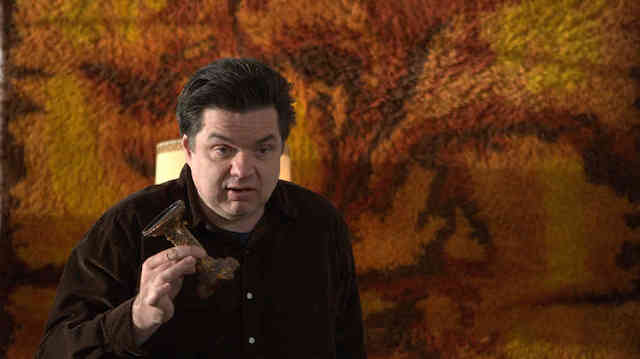
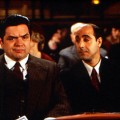
DIGGSTOWN (1992), THE IMPOSTERS (1998), PIECES OF APRIL (2003), CASSANOVA (2005), THE ICE HARVEST (2005), PLEASE GIVE (2010)
Our newest feature salutes some of the great character actors with a primer on their greatest performances. In our first, we saluted the outstanding performances of recently deceased actor Bob Hoskins with Six Essential Performances. This week, a look at six brilliant, and sometimes overlooked roles of Oliver Platt.
Oliver Platt (Currently in Chef, TV’s Fargo, upcoming Lucky Them) is the kind of actor who completely catches you off guard, despite being a familiar face for more than 25 years. In every movie and television show he appears in, it seems impossible to think of any other actor in the role. He adds variety and humanity to the broadest of characters, but despite how great his performances are, there is always something uniquely his own; as if a tiny bit of himself can’t help but infuse every characters. It’s the reason he does so well with significant supporting roles, adding far more to his characters than what exists purely on the page. Like a modern day William Powell, this Shakespearean trained actor has a wild charm, even when playing incredibly unlikeable men. It’s no surprise that even in films which are less than brilliant, his performance always stand-up.
Oliver Platt is the kind of actor who completely catches you off guard, despite being a familiar face for more than 25 years.
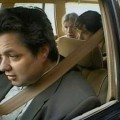
If you missed The Imposters, you missed a gem of a film.
Despite his unbelievable ability to play less than attractive crazy people, Platt brings humanity to every role, no matter how big or ridiculous. But some of his nicest moments come from understated everyman roles, such as in Pieces of April. Platt is really just playing a dad; a warm-hearted, exasperated father who only wants his wife and daughter to find some common ground. In a movie with some larger than life women, Platt’s low-key performance would be easy to overlook if his interplay with of the women hadn’t offered them some of their key emotional moments in the movie. And while his interactions with Allison Pill, Katie Holmes and Patricia Clarkson are beautiful, the quiet moments he has with John Gallagher are easy to overlook, but brilliant, especially when you see how much he does in the corner of the screen.
2005’s Casanova earned Platt the New York Film Critic’s Award for best supporting actor and is a great example of a subpar movie elevated by Platt’s performances. The movie itself is a bit labored and uninspired, except for Platt’s performance as Papprizzio, which is a breath of fresh air. The remarkable thing about watching Platt here, especially compared to the rest of the film, is the ease at which he takes on historical costume films. His theatrical background, and Shakespearean training particularly, helps him to approach the film with an ease few contemporary actors have when dealing with classical material. Despite costumes and language, Platt seems completely at ease in the role, and plays the role with unhindered delight which captures the original spirit of the scandalous novel.
Earlier this year, due to the tragic death of Harold Ramis, the underrated film The Ice Harvest found a bit of a second life. The noir comedy starring Billy Bob Thornton, Randy Quaid, and John Cusack features a hilarious performance from Platt as Cusack’s pathetic, drunk friend. Despite the film not being a straight comedy, Platt’s comic relief is so welcomed and his character so fully realized, he never comes across as an afterthought or unnecessary part of the story. He is completely believable as a man who seduced Cusacks’ wife away, even while already being a man on hers (and everyone else’s) nerves. Hilarious in a role which is farcical in its broadness but real in how unlikable and childish he goes with the character, it is one of the best part of this little gem. And according to Ramis, the role was unwritten until Platt took the role, developing aspects of the character to make him a more interesting and dimensional character.
Likewise, his role in Please Give was created for him by writer/director Nicole Holofcener, who invited his input on writing a three dimensional, middle aged man for her movie about a New York couple (Platt and Catherine Keener) who make a living buying furniture from estate sales, and live with real and misplaced guilt because of it. There are elements reminiscent of Platt’s put-upon, dependable character in Pieces of April, but has a bit more to do in this film. His character has slowly been losing patience with his self-hating wife, and responds to her claims of being ashamed of their life with a tired, droll sarcasm. But behind all that is a midlife crisis and denial which leads Platt’s decent but imperfect husband and father to have the biggest moments in this female focused movie. And like all his best work, there is a complete lack of vanity here which allows him to embrace the best and worst aspects of his character’s humanity.
What is Oliver Platt’s greatest performance?
