

Martin Sheen and Emilio Estevez on The Way
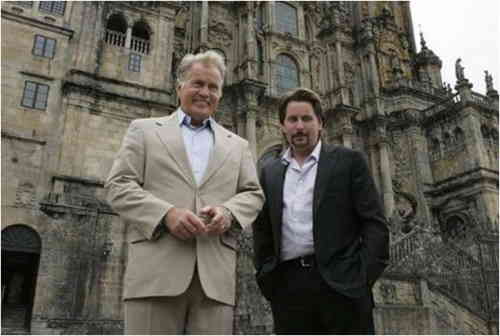
 Last Friday Martin Sheen and Emilio Estevez stopped in to talk about their new film, The Way, which Sheen stars in, and Estevez wrote and directed. Of course you know them both from a long series of great film and television projects. Emilio was an 80s teen movie icon in films like The Breakfast Club, St. Elmo’s Fire, and the cult classic Repo Man, and then later in The Mighty Ducks, and Bobby. And Martin Sheen’s distinguished career includes the iconic Badlands, Apocalypse Now, The American President, the television series The West Wing and so many more great roles. The new film follows the journey of Sheen’s character along the great Camino de Santiago in Spain. What follows are excerpts from that interview.
Ron Bennington: How you guys doing, man?
Emilio Estevez: We’re doing just great. Thank you so much…
Ron Bennington: First of all Emilio, right of the bat, congratulations. I love the fact that I did not know what to expect in this film when I walked into it. I had read very little about it. And just to let it just open up like that was amazing.
Emilio Estevez: Thank you. You know this was a movie that was inspired by my son, initially. He went over to Spain in 2003 with my father and came home from that trip announcing that he had fallen in love and was going to move back there, and he did! He married the love of his life on the Camino de Santiago. And his mother in law’s name is Milagros. And milagros means miracle in Spanish.
Ron Bennington: Now why is this path even a pilgrimage, why is this sacred ground?
Martin Sheen: Well it started a little more than 900 years ago with the discovery of the remains of the apostle Saint James and they are interned in the cathedral in Santiago de Compostela and they are the object of pilgrimage. And the pilgrimage now goes from the French Pyrenees across northern Spain to this spot where the remains are venerated. And the pilgrimage is 800 kilometers which is about 500 miles. People from all different walks of life and religions and non-religions; people looking for something, people trying to find themselves or some measure of importance in their lives go on pilgrimage to try and experience that transcendence.
Ron Bennington: The Man on a journey, I think is probably the first story that’s ever been told so you really are re-telling a story, but ‘the’ human story.
Emilio Estevez: It pays homage to Homer’s Odyssey. It pays homage to Canterbury Tales and Conrad’s Heart of Darkness. It is a journey whether it’s a road or a river and we come to find ourselves at the end of that only to discover it was never about the destination it was always about the journey.
Ron Bennington: And Martin starts this at the very beginning of the film as a widower who also finds out that he’s lost his son. And this is two things that no man will put up with…this is the biggest fear any man could have, burying his wife, burying a child. So we’re starting at a point that…it’s that dramatic point. But I noticed you didn’t let him fall real far. It wasn’t this devastation thing. You kind of kept him really tight at the beginning. Why was that?
Emilio Estevez: I wanted to create a guy that was emotionally shut down. He was emotionally bankrupt, essentially. He is holding on to his lifestyle, his California bubble life, that is very comfortable to him. He’s not an emotional guy, he’s a very controlling guy. And here he is now, totally alone in the world. And he’s going to have to figure out a way to get back to finding some measure of community. I couldn’t have him be entirely closed down. We had to see some glimmer of an opportunity to get in there.
Martin Sheen: He comes from the worst loss to the greatest healing; the greatest realization. He becomes a father to these fellow pilgrims that in the beginning he can’t bear. And he realizes that so much that he dislikes in himself is present in these people. And when he begins to accept that, and be forgiving and loving toward them, then the transcendence starts in him. And he becomes the father to them that he was never capable of being to his own son, in life.
Ron Bennington: And I think that is the spiritual journey. Whether or not you take the physical journey or not. The spiritual journey is– you have got to be open.
 Martin Sheen: That pilgrimage is an opportunity to unite the will of the spirit to the work of the flesh, and we don’t always know that consciously. But in order to do pilgrimage you have to leave your comfort zone and pack up all your necessary accouterments for the journey. But as you begin that journey it’s not long before you start disposing of some of the heavy items that you over-packed, and then the transcendence begins. You begin to unpack a lot of the baggage that you’ve accumulated, the people that you’ve kept locked in the dungeons of your life. The people who’ve made your life miserable and ruined your opportunities. You begin to open those cells and let them out and you stop judging and coveting and hating, and eventually you become your true self– the possibility of freedom.
Ron Bennington: I think one of the greatest things is, he starts as an eye doctor with a great practice; …..spiritually blind….
Martin Sheen: (everyone laughs) That’s not an accident
Ron Bennington: ….and all these people that he had met, were people that if he’d met in Los Angeles, would have maybe had 60 seconds of his life, tops.
Emilio Estevez: But isn’t it the way though? The people that you most despise, the people that you don’t want to have anything to do with, are ultimately the ones that teach you the biggest lessons about yourself.
Ron Bennington: It took a long time to get this film done I guess? It’s so far from being a Hollywood movie.
Emilio Estevez: There’s no CGI, there’s no vulgarity, no violence, nothing blows up…
Martin Sheen: You can take your parents, or your grandparents, you can take your children. No one has to cover their eyes or their ears or be insulted or degraded by what they’re going to see and hear.
Ron Bennington: And its one of those films that while you’re watching it you can’t help but think about your own life. So for you guys to put that out there, you’re really walking a razor’s edge. How to tell that story without preaching…how did you get to that point?
Emilio Estevez: Well, we’re very close, and physically close too. I live right down the street from my parents. They are going to celebrate their 50th anniversary this year. I consider them my best friends. So the film is really an extension of that. An extension of our lives and how we live them every day. And we don’t preach in our lives.
Martin Sheen: Nobody listens anyway (laughs)
Emilio Estevez: So for us, when I began to write this script and develop this character, I said to my father– we all know where he stands in terms of his religion, he’s a very devout catholic..
Martin Sheen: I’m a practicing catholic, and I’ll continue to practice until I get it right (laughs)
Emilio Estevez: So I said to him, Pop, I think this character is going to be a lapsed character. And there’s silence… He says, ‘what do you mean?’ I said lapsed catholic. We’ve got to have somewhere for you to go. He says, ‘well I want to stop here at this church and I want to cross myself and I want to cry here’, and I said, no, that’s not going to happen. I assure you, that’s not the film that I’m interested in making. If you want to go on this journey with me, here is the character, and you will be ruled by me because he’s got to have someplace to go and I think we can say a lot more if we don’t start out where he’s this pious guy and he’s got things to say. I want him to be very quiet, and I want to watch the change happen on film.
Martin Sheen: And you know it’s the best part I’ve been offered in 30 years. It’s the first time in 30 years that I’ve been asked to carry a film. And this guy’s in a class by himself. He’s my closest friend and I adore him. And he knew all of the buttons to push because he helped create the machine, and so he guided me through this very sensitive pilgrimage, and together we made the journey and the film is a reflection, I think of how we feel about each other, and the optimism we feel about life in general.
Ron Bennington: And there’s beautiful scenery but you never see the characters stop and say oh my god, look at this beautiful scenery. There’s a couple of scenes, I’m like slow it down, I want to just be here for a moment.
Emilio Estevez: We had this idea in mind that we’re in the extraordinary country, we’ve got this amazing light. Let’s throw it away. Let’s not be precious about anything. Let’s keep moving.
Ron Bennington: And you guys physically shot this moving along? Did you shoot it in sequence?
Emilio Estevez: In sequence, yea, we started on the 21st of September, 2009. We finished it 40 days later on the water in Muxia which is 900 kilometers, or almost 600 miles.
Ron Bennington: It actually takes its time. It reminds me somewhat of a 70s movie in that way, that it’s not being forced along by dialogue or plot, but kind of the way life moves. If he doesn’t suffer for a while, what lesson would be learned anyway?
Martin Sheen: Anyone that’s ever made a contribution on any level to humanity throughout our history has had to suffer and usually the greater the suffering the greater the contribution.
Ron Bennington: So the kind of places that you sleep in, and I don’t want to give away too much, they’re as a far away from what an American would think of as a restful night…all that stuff is authentic?
Emilio Estevez: Oh yea, we shot in actual albergues, bed and breakfasts.
Martin Sheen: They are like homeless shelters.
Emilio Estevez: Some of them are.
Ron Bennington: And is that because the Europeans need less personal space than Americans?
Martin Sheen: Ironically its very part and parcel to the journey. Because it’s really about– each individual pilgrim must carry the things that they’ve accumulated both interiorly and exteriorly. And they must make the journey themselves. Nobody can walk it for you or carry your pack. You have to do it alone and yet you cannot do it without community. So when they get to those albergues and refugios, the whole community comes together. They have to help prepare the supper they have to help each other do the laundry and they share a great deal during the night. It’s like being in camp.
Emilio Estevez: And they have to trust each other. Cause there you are…with everything you’re going to have, physically– everything you need for the next six eight weeks – and there you are leaving it unattended on a bunk. And you have to trust your fellow-man not to rip you off.
Martin Sheen: And we never ever experienced any theft or any grunt from a pilgrim and no complaints. People embrace it as part of the journey and that’s what makes it so deeply human– is– you have to share your burden.
Ron Bennington: Its phenomenal too– how little American films have been shot in Spain. Woody Allen did one not too long ago, and you were like, wait, where is this place? Because we’ve shot Italy so many times, and France and Germany.
 Martin Sheen: The Camino is a long and arduous journey but there’s accommodations for everyone. No one is left out anywhere. It’s just not part of the culture. They’re hospitable. But they don’t really brag about themselves, they don’t really export their culture very far. You know and when you get to Galecia its like another country really. And my dad was a Gallego, He was raised just about 80 kilometers from Santiago so I knew about this pilgrimage all my life and so doing the film was a culmination of a dream really. But the Galecia is the most rugged part of Spain and so many Gallegos found it easier to get to the new world sailing out of Vigo than it was to get to Madrid. It took an equal amount of time to get to Cuba as it did to get to Madrid so they were forced to be very independent.
Ron Bennington: Yea they don’t really have that much of a connection to …..even though the Spanish people are all over the world. You know how you always see Irish people go back to Ireland, but you never hear about that trip back to Spain.
Martin Sheen: Oh they do. You know my dad retired in 1965 and it was his dream to go home and live out his remaining years in Spain. He lasted six months. You know they’d just gotten electricity and he was isolated. He had to grow his own wine and plant his own potatoes, and thought, no, I’m too old for this! So he went back to the States but he left us a wonderful legacy. And one of the most rewarding parts of the film was a surprise and a wonderful one at that. We were watching a screening of the film, my sister and I and suddenly the credits come up and Emilio had dedicated the film to his grandfather, who was my father, Francisco Estevez the Gallego.
Ron Bennington: And you didn’t know that was coming.
Martin Sheen: Didn’t have a clue and I burst into tears.
Ron Bennington: So family plays such a big part of this, but also family of man. This is, like we said, the human story and no matter what you do, you are walking this way.
Emilio Estevez: But that’s mans first instinct. One of them anyway. You know you get out of the cradle. And now you’re down on all fours, and what are you longing to do? You stand up. But to get on two feet and then move forward and that is an instinct.
Ron Bennington: And you do have to play every part to have a full life. You have to be warrior and medicine man at different parts of your life. It is an extraordinary movie and the best thing about it is it comes as a surprise. I can’t wait to talk to my friends about it after they’ve seen it. It was so great to see you guys, man. I’m happy for you both.
Martin Sheen: Thank you for your good words.
The Way, starring Martin Sheen, directed by Emilio Estevez opens limited on October 7, and then we goes wider on the 14th and still wider on the 21st.
==================================
To hear the interview in its entirety, tune in to Ron Bennington Interviews on Stars Too and The Virus channels on Sirius XM Satellite Radio. Don’t have Sirius XM yet? Click here for a free trial.
For more information on the film follow @EmilioTheWay on twitter or visit the official website here.
Also you can check out the trailer for the film below:
