

James Cromwell: An Artist and an Activist
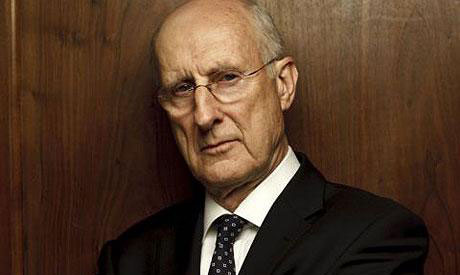
 James Cromwell has a long and incredibly varied acting resume. Some of his great film roles include L.A. Confidential, The Green Mile, Star Trek First Contact, Babe, W; and of course he’s had many great television roles as well, like ER and Six Feet Under, just to name a few. Last week he stopped by the SiriusXM studios to talk with Ron Bennington about his role in one of the most talked about films of the year– the award-winning film, The Artist. Below are some excerpts from that conversation.
Ron Bennington: Congratulations, being in a film that has this much excitement around it. Particularly since it’s so different from every other film that you’ll see out there this year.
James Cromwell: It’s actually not. It’s silent and black & white. So that’s the difference. But actually it’s a very contemporary story. Modern story. Just set in 1928. It’s a love story. A guy resisting change and then sort of, being beaten up by it and then 3 people, friends come to his rescue.
Ron Bennington: And yet, it’s so funny as we go through film, it is kind of always the same stories though. And you could go back to the beginning of time and we only have so many stories and the way that we tell them.
James Cromwell: There’s a difference because there’s a plot which people think is the story, but actually the narrative is how the characters respond to story and that’s very much different. Boy meets girl. Boy gets girl. Boy loses girl. Boy gets girl back. That’s very simple. But of course what happens in the “boy meets girl”, how he meets her, what he does, is different from one thing to another. And when it’s a work of art, it tends to the story then goes past the plot line to involve other things. It involves who we are as human beings, how we relate to each other, the nature of sound, the nature of silence, what it is we communicate without words, how we can talk to each other, how we can be more truthful. One of the differences in the film is this film is not at all cynical. It’s not cool. In many films today, whatever people are saying, they’re not telling the truth. You know that. So we watch it and we try to figure out what’s the hidden meaning. But there is no hidden meaning in this. Everybody speaks because they’re not talking. Everybody says, indicates exactly what they feel. Then the audience responds to that.
Ron Bennington: And I was actually telling Harvey Weinstein this. When I saw the film and then left the Paris Theatre, all the faces in New York just kind of exploded to me.
James Cromwell: Sweet.
Ron Bennington: That you’re just finding yourself paying attention and I don’t whether because some of the other senses were taken away for a little while, but suddenly everybody’s face is telling a story to you as you’re walking down the street.
 James Cromwell: Well that’s what actually happens in the film. You have to create the story as an audience in your own head from the expressions. So another film, it would just be a minor part. Some guy who sells off his property. But this time, you watch the man when he comes out and says something because he says to the guy “so everything is gone” and George the lead man is sort of wounded by this although he’s made money. And the auctioneer’s face drops. Just that little moment you realize oh, he’s a human being, he cares about this guy. So you notice that people, we do say a lot more to each other about who we are and what we feel about each other from our expressions and gestures than we do from what we say to each other.
Ron Bennington: And this is what we expect in Shakespearean acting that we as an audience member need that extra help to pull that out.
James Cromwell: That’s right. That’s good. That’s often left out of Shakespeare, but that is quite true of Shakespeare.
Ron Bennington: For your work though, how do you know as an actor, when you say something’s a piece of art, when you’re reading that script, can you tell if something’s going to go on and be art or commerce? Or it’s too difficult?
James Cromwell: No. You can’t even, if it’s a regular sound film, you never know because it’s a director’s medium and it really occurs in the assemblage in the editing room. I talked to Michel Hazanavicius for about 3 hours to try to find out was this just a gimmick? Was he just doing in black & white and silent because it was a way to hang the story? The story was very straight forward. But he presented it, not in a movie script like we usually get, it was a short story on very nice paper with photographs of Bérénice and Jean in front of the Bradbury Building or Paramount or whatever. And I said “Well, why did you want to do it in black & white and silent?” He told me, but I didn’t get it. It wasn’t actually until I sat in the theatre with an audience and experienced what they experienced and said “Oh, I get it now”. The story doesn’t exist in the script that exists in my head. It’s what I make up about the people, the images that I see. Then it becomes not only more engaging, but it deepens depending on your creativity and your willingness to empathize. I mean I wind up being moved by the same story and I’ve seen it 7 times. And it still gets me.
Ron Bennington: Yeah, I felt the same way. And I’m glad you put it that way too because it’s asking for us as an audience member to become involved in this and so many times I think with not just film, but different types of entertainment, we’re left out. We’re almost spoon fed so much that we start to drift off. We get over amped on the action or the comedy is just coming at such a clip that there’s no build up to it.
James Cromwell: Michel said that people can now actually be on their smart phones texting somebody and still hear enough of the movie in their ears with the dialogue to be able to know what the story is. But you can’t drop out of “The Artist”. If you drop out of a scene in “The Artist”, you’ve suddenly lost a part. So you have to stay really focused.
Ron Bennington: Now you’ve been involved in so many political and social issues over the years. Do you go looking for that type of stuff to tell through film or you keep that separate?
James Cromwell: Well if I did, I’d have to look pretty hard because they’re really not making many of those films anymore. I mean I wouldn’t do something that I thought violated something that I truly believed in. And I never have been asked to, I don’t think. I don’t think I’ve turned down anything. I’ve been really lucky. I think the projects have chosen me. I’m fairly outspoken so I guess a lot of producers know what they’re getting into when they hire me. I remember when we did “W”, I kept coming in everyday, I would read on the internet, something about that family. Some other horrible story. And he finally said “Jamie, if you keep having a judgment of him, you’re not going to be able to play him”. Which is the truism that you hear from when you start acting school. But it was actually true. And was wonderful that he got me out of it in the first scene. He kept on saying to me “No, no. More anger. More.” And I said “But George Bush doesn’t, he shoves all his emotions down”. But actually the story that he wanted to tell was the relationship between a father and the son. Which I knew as a father and had missed when I was reading the script. I thought I had an obligation to come with a new impersonation of George Bush, but I didn’t. I only had to be a father.
 Ron Bennington: And that was the most human part that we could all identify with. I was thinking about you earlier this year too when I saw “Black Power Mix Tape”. I don’t know whether you had a chance to see this documentary.
James Cromwell: I haven’t seen it at all.
Ron Bennington: It’s fantastic. It’s about the Black Panthers and it’s this footage that was shot by Swedish filmmakers back in the 1960’s. And we’re kind of seeing the Panthers through these Swedish filmmakers’ eyes. And so many of the things that the Panthers had done that I read that you talked about before.
James Cromwell: What was happening actually is wherever there were Panthers, they dealt with a community that had needs, and they addressed those needs. Of course, the corporate media and the power structure only saw the threat that they represented, but that’s true of people of the Black community in general. That’s why a lot of them are arrested for drug related crimes or gang related and the best and the brightest wind up in our prisons instead of being in the communities to make a difference. Because the thing is we’ve always wanted them to be the underclass. And so the Panthers just said that’s not gonna work. And they put it into effect. It was like a lot of the movements. We polarized the country and the country could not see what we were actually trying to accomplish. And even though we could articulate it, we were just talking about the Occupy movements not being able to articulate its agenda, but of course, you can’t in the middle of protests. You’re basically saying “It’s not working and it’s not right and it’s not fair and it’s not just. And somebody’s got to do something about it”. Then you have to make the transition from that protest into some kind of organization in some kind of mass national movement. But it’s gonna come. It’s started already. Revolution has started.
Ron Bennington: You honestly feel that it is coming down?
James Cromwell: It’s coming down. Absolutely.
Ron Bennington: I know from reading about you too, your father was blacklisted. And here when you look back over that period and see how few of the people in the Hollywood community came together for that. When some of those guys got blacklisted, everyone else just fell into line.
James Cromwell: Yeah, they actually tried it, Humphrey Bogart and Bacall and a number of people went to Washington because they thought that somebody would listen to them. That it was unfair. Got to Washington and saw what was arrayed against them and were threatened. And they came back to Hollywood with their tails between their legs. There were people who stood up to the committee, they lost their careers, Will Geer, lots of people. And there were people like my ex-father-in-law Lee J. Cobb who testified because he was so frightened that he would never work again. People think that that can’t happen again, but it can happen again.
Ron Bennington: It starts to happen pretty quick too. As soon as the comfort levels are screwed with.
James Cromwell: Well, my personal opinion based on my father’s, I believe that the blacklist was basically and the House Un-American Activities were to try to get the Jews who actually ran the studios to toe the line and not make films about what was going on in the country about this cold war, this manufacturing of an opposition that forced us to keep the military industrial complex funded. And they were going to point that out and they wanted to pull all those liberal and socialist and intellectual people out of Hollywood and create this propaganda machine where things are wonderful just the way they are. And I think that’s what the blacklist was really about.
Ron Bennington: What’s really odd too that you bring that up is because of those films from the 50’s, I kind of feel like Americans are nostalgic for an era that almost never even happened. It’s a really strange thing that those films that stay with us today, even though many of them weren’t very well made or whatever, and yet for some reason people forget that the 50’s had Jack Kerouac or Miles Davis and that…
James Cromwell: Not in the films.
Ron Bennington: Yeah, they weren’t in the films at all. They were completely forgotten about. Whether they were in the underground in the Village or whatever, but people look back to this thing that I’m not sure ever existed with the happy suburbs.
James Cromwell: There’s a wonderful book that I always wanted to make into a film called “Her First American” which is about a holocaust survivor who comes to New York and she meets a 50-year-old Black man who was a Magna Cum Laude graduate from Harvard and was a Rhodes Scholar and went to Paris and came back and worked for Ralph Bunche and he shows her America through the eyes of a Black man in the 50’s. Which is a completely different way to see our entire culture from the underclass point of view which is really, someday I hope I get the chance to do that film.
Ron Bennington: Is there always things like that that you’re looking for?
James Cromwell: Always. I have a film called “Without Blood” that I want to do which is about male violence, about our propensity to solve every conflict using violence and how women’s compassion and forgiveness offers an alternative to that, it’s a wonderful story.
Ron Bennington: And do you think that’s just the way all of us were raised?
James Cromwell: It’s not who we are. But it is the way we were raised. It’s not who we are as human beings. We as human beings are cooperative. We work together. We sacrifice. There are altruistic acts. But the culture that we have been taught, this idea that it is survival of the fittest, that in this abstraction called money and power there’s something of value. There is nothing of value. What is of value, the human experience, the experience of the heart is what we have to strive for and get out of this idea which comes from much lower down about dominance and coercion and violence and force.
Ron Bennington: Are you still optimistic though James?
James Cromwell: Have to be. You have to be. I mean I know it looks really grim to people. I can’t imagine what it’s like to be young now and to hear this over and over again and watch how adults are not paying attention to what’s going on in the world, but I have to believe that our humanity, that we will not only endure, we’ll prevail.
Ron Bennington: I just feel it’s so rough for young people like you said. Numbers came out about how many people in their early 20’s are not working at all. And I know that my father came back from World War II and was able to buy a home and get a job in his early 20s, start a family and now people in their 30’s don’t even think about such things.
James Cromwell: I think the next movement is going to be the student loan thing. I mean we’re are going to have a lot of people who are gonna say “You know you are asking me to make myself a wage slave to do something I don’t want to do, to pay back a debt that I really shouldn’t have incurred in the first place and I refuse”. Now when they all refuse, if they all refuse, it’s like when I was in Ethiopia. I was hitchhiking around the world. And every student in Ethiopia struck and I talked to a college guy, he looked around to see if there was any secret service and then he said to me, he said “I don’t care which way it moves. It can move to the left or the right as long as it moves”. I think that’s what we have to do.
Ron Bennington: I agree.
James Cromwell: We have to get them to move and pay attention to the needs of people.
Ron Bennington: I tell you, you bring up about those kids, I have so many kids that come here. They’re either interns or starting salaries and they’re already $150 – $200 thousand in debt. And I’m like I don’t know why anyone in that school who’s a professor couldn’t have told you this is a bad idea.
James Cromwell: Bad.
Ron Bennington: Because you probably could have done this job, if this was the job that you wanted to do, you didn’t need that education that you got. You’d have been better off hanging around a radio station.
James Cromwell: Our educational system is broken, our health system is broken, our infrastructure is broken, our relationship with the environment, our relationship with the rest of the world is broken. We gotta fix this.
Ron Bennington: We do. “The Artist” is playing in select theatres. It is one of those films that go to with an open heart because it’s a fine fine film. The WeinsteinCo.com for more information for it. James, thanks so much for sitting in here today.
James Cromwell: My pleasure. Thank you.
============================================
You can hear this interview in its entirety exclusively on SiriusXM satellite radio. Not yet a subscriber? Click here to get a free trial subscription.
