
Aida Rodriguez Brings Universal and Personal Truth to Her HBO Special, Fighting Words
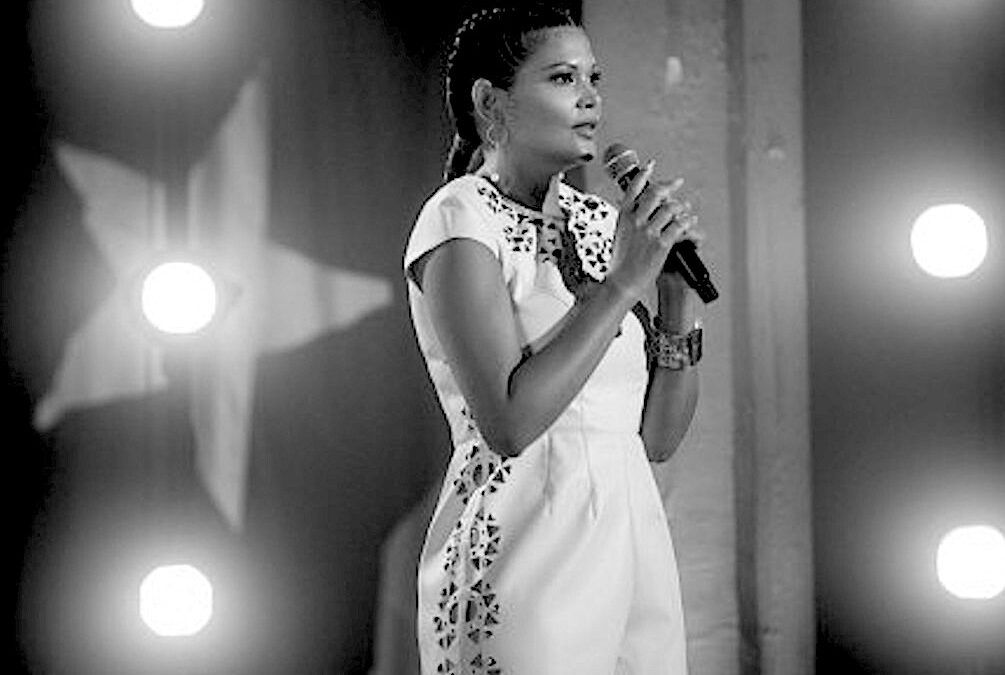

Comedian Aida Rodriguez dropped an HBO special this month. Fighting Words is her debut special, and she comes out swinging. It’s a terrific representation of herself as an individual and a member of the LatinX community, and as a woman.
Aida has always used her comedy to address difficult circumstances and complex topics. She steers into difficult concepts, breaks them down, and finds what makes them funny. Her no-bullshit approach to life and to comedy is a big part of her appeal and all of those qualities are present throughout Fighting Words. It’s both personal and universal, a street smart special filmed in the Bronx that gives us insights into our culture as well as Aida’s own struggles and triumphs.
She’s always been a fighter, for herself and for others like her, those who define themselves as women, LatinX and other people of color. When I spoke with her about the special, she explained a bit about where that fight comes from. “I don’t know any women that are Latina that have broken the ceiling in comedy. I don’t have anyone to look to, in terms of what it looks like to have ultimate success. I’m still worrying about how I’m going to pay my mother’s bills and my bills in the next coming months. That’s my reality and I know I don’t do this for the money. I do this because I truly love the craft, but I don’t know what that looks like in terms of Caribbean comedians, I think Freddie Prinze is of most famous in history because John Leguizamo, he’s more of a sketch, stage theater type of guy, funny and amazing. But in terms of pure stand up, I don’t know of that. And so for me, I have to be what I want to see. And I think that it is important for us to have a voice, especially as a Latin woman. Latina women are not usually perceived as being some people that have a point of view on social and political issues. The way the media frames us is over sexualized, pretty simplistic, very pleasing. And so I step out and say, that’s not who we are.” That’s changing now, she said, talking about Wanda Sykes, a role model and hero who is melanated. And she mentions Chloe Hilliard and Yamaneika Saunders, as women who are really talking about things that are uncomfortable and facing social issues. “But I don’t have a role model for that. So I had to become my own and I decided that I was going to really talk about things that you don’t hear that much coming from my community because they’re not giving a lot of people, the microphone. Not because we don’t do it, but because we just don’t get the platform and the opportunity to do it.”
Fighting Words embodies all of that aesthetic and Rodriguez is certainly on her way to representing that ideal. On stage she is powerful with a distinct point of view. Her stand up is topical, covering important socio-political issues, racism, colorism, wokeism and all the isms that are cultural flashpoints in 2021. And she covers the topics in a way that doesn’t feel in danger of becoming outdated. But Fighting Words is also deeply personal. The standup is only part of the story. Aida’s hour includes a very unique documentary that’s all about Aida’s personal history. She leaves New York, determined to examine her roots, traveling to Puerto Rico and the Dominican Republic, where her parents are from. I asked her why she chose to include the documentary in her stand up special, which surely could have stood on its own. She explained that she wanted to use this platform to shine a light on people who don’t get to see themselves reflected positively in American media.
“When I say these people I’m talking about the indigenous and black people of the Caribbean, who when you see in media, you tend to see in very stereotypical roles. But I decided that I wanted to use a piece of my pie and just show the beautiful people of Puerto Rico and the Dominican Republic, because people love JLo and they love Mark Anthony. And they love these reggaeton artists. They love Bad Bunny. But they don’t love Puerto Ricans and Dominicans. And it’s like, you always take the most famous parts of us. But then you forget about the people who are the essential people of those countries. And so I wanted to show the beautiful people of those two countries and not highlight the negative part of it. I wanted to show love and light because everywhere you go, that outnumbers the negative.”
Of course the question of how to connect the documentary to the standup remained. She met with her directors, and came up with the idea of sharing her comedy process, showing how elements of her life make their way into her performance. “And so that was the connector of how I was going to tell the story by showing the beautiful people of my two countries, but giving it a purpose and informing the jokes.”
You see this come together most clearly in the last segment. When Aida journeys to the Dominican Republic, it’s not only to connect with her family. She’s going to meet her estranged father for the very first time, and she’s doing it on camera. Later she will perform stand up, using some of her experiences as material. Filmed family reunions like these are often highly emotional moments filled with tears and joy, or dramatic confrontations, but Aida’s meeting with her father is neither of those things. Although her father cries at meeting her, Aida herself is powerfully devoid of emotion, and you can see that she is meeting with a person who is a stranger to her in every way.
Aida told me what was going through her mind during that meeting. “I was like, I know who he is. I know what he is to me. I don’t know him. And that was the actual first time that I saw him. There was no rehearsal. There was no second take. I wanted that moment to be a real moment. And I wanted to free other people who have gone through this. White, black women, non-binary, anybody who has had this experience to know it’s okay to feel whatever you feel in that moment. Whatever it is, is okay. Because I think that this situation is always romanticized, this reunion, because you see these reality shows and these talk shows. You’re like, “Oh my God. It’s my son” and then there’s a hug and a cry and we’ve repaired.”
That’s not to say that the meeting was insignificant to her. On the contrary. “When I saw him, it was absence of this man that created such a void in my life that impacted me,” she said. “I had a major breakdown before and it wasn’t on camera. It was just as I was getting ready, I was like, “I don’t know what to wear. I’ve gained weight. He’s going to think I’m fat. He’s going to think I’m ugly. He’s going to think I’m old. He’s going to think I’m not his little girly. I mean, all of this stuff was going through my head and my kids were the ones who calmed me down. And they held my hand. I cried for an hour before it happened. I had been crying my whole life. It was his turn to cry.”
The documentary shows Aida debating how to talk about the experience on stage. She is aware of the dual responsibilities she has here- one to represent truth, the other to shine a positive light on her community. “How am I going to tell those jokes about my father and the Dominican Republic, in a way that doesn’t seem like I’m perpetuating stereotypes about Dominicans?” she says on screen in the special. “That’s how much shit I have to think about when I write a joke.”
I asked her how she deals those questions. “It is the stuff that we have to think about, right? Because now that there is a hot seat that you can be on. And for me, I don’t want to police other comedians. I don’t want to tell anybody what they should or shouldn’t say, I think you should be able to say what you want to say. You should just be prepared to deal with the consequences.,” she said, adding, “I really want to do good jokes. I want to do good comedy. I want the comedy to mean something.”
The journey was both a labor of love and a painful journey. “But I’m glad that I went through all of it because the response from people who have been dealing with some of the things that I’ve been dealing with has been great, but more importantly, a lot of people, it really hit them. What a comedian’s process is sometimes when they’re talking about these types and what goes into us, talking about painful things in our lives, that comedians are not just people who wake up in the morning and decide that they want to be funny, that there’s a lot of pain and trauma that goes into a comedian set and how we live our lives.”
When the filming was over, Aida said she went into a bit of a depression. She worked years to get to this moment, and now, it was over. “I put so much into it. It was a long process to get there. There was a lot of work and then it ends and then you just put it out there and hope that of people will receive it.”
You can watch Aida Rodriguez, Fighting Words streaming now on HBO Max.
