

Talking Comedy and More with Stephen Merchant
 Writer, director, comedian and performer Stephen Merchant does it all. He is best known as co-writer and co-director of the British series The Office, of course. And his many collaborations with Ricky Gervais have resulted in brilliant work in so many different areas of media including the BBC show Extras, The Ricky Gervais Show, An Idiot Abroad, and coming soon, the sitcom Life’s Too Short. He has written, directed and/or performed for almost every medium you can think of, including television, film, radio, podcasting, audiobooks, animation, on stage and even video gaming platforms. He stopped by the SiriusXM studios recently to sit down with Ron Bennington for an episode of Unmasked to discuss his extensive career. Brief excerpts from that interview appear below:
* * * * * * * * * *
Merchant talks about performing stand-up in the U.S.
Ron Bennington: It’s good to have you. Stand up. Now in the U.S. You did this huge tour of Britain, now you’re bringing it over here to the states.
Stephen Merchant: Yeah, I’m nervous.
Ron Bennington: What has you worried?
Stephen Merchant: Because I adore American humor. I grew up listening..I was obsessed with like Woody Allen and stuff like that. And so I feel like understand American humor, but I don’t know if I do. And I’m worried that..will it translate? I spent the day going through, changing, you know, “pavement” to “sidewalk”.
Ron Bennington: Because we will react awful to anything.
Stephen Merchant: Because you will go furious. He said “pavement”!! It’s a sidewalk buddy!! (audience laughs) People are just leaving….seats clattering up.
Ron Bennington: But you said you grew up enjoying Woody Allen so you’re…
Stephen Merchant: I feel like I’m very, kind of…I would love to be basically a short Jewish New Yorker. That would be my dream. Like if I could make that happen, I would adore that. I was lucky enough to shake his hand once at some event. And he had no idea who I was and why should he? And that was enough for me. I can die a happy man.
Ron Bennington: What was the event?
Stephen Merchant: This was, I think he was doing a screening of one of his movies in the U.K. and I was able to sneak in and I remember there was a moment where he was taking questions and we were just doing our show Extras at the time. And we were thinking it would be great to get him in the show. And so he was taking questions and I had my hand up and I was going to say, and he said on the stage “No one ever asks me to be in stuff as an actor. They always think of me as a director. They don’t ever ask me to do stuff.” And so I thought, I’m going to ask him here. And like an absolute English gentleman, I allowed the lady next to me to ask her question, thinking I’ll be next. They went “That’s it for questions”. Wrapped up. And since then I’ve never been polite. I’ve never let a lady go first for anything. (audience laughs)
Ron Bennington: Now did Woody end up doing her show? (audience laughs)
Stephen Merchant: Yes exactly. Right, yeah.
* * * * * * * * * *
Merchant talks about working with David Bowie and other big celebrities:
Ron Bennington: Well even in Extras when you guys had Bowie come on. I haven’t really seen Bowie even do albums in the last ten years. I’m a giant fan of his. And that one thing is all I’ve really seen out of him after all this time.
 Stephen Merchant: Well that was all due to The Office. We read in a paper or something that he was a fan of “The Office”. It’s so strange to me that David Bowie has watched something we’ve done. Like the idea that he took the cellophane plastic off the DVD. “Iman, I’m having trouble getting it started here. Iman, you’ve got longer nails, could you just get that?” (audience laughs) It’s just weird to me. I remember Ricky phoned him once to talk about the show and Ricky said he picked up the phone and David just went “Sorry Rick, I’m just eating a banana”. (audience laughs) Just the idea that David Bowie eats bananas is amazing to me.
Ron Bennington: But when they show up they show up to play.
Stephen Merchant: They want to have a good time. And I think actors like to act and we give them great freedom. We never spring anything on them. They always know what the script is. But they’re free to improvise, play around and go crazy. And there’s no hanging around in trailers. They come in, boom, we’re straight into it. And I think, I don’t know, I hope they enjoy that. It’s a day off for them, from their real careers.
Ron Bennington: But for you as the writer, you want to make sure you take care of these people.
Stephen Merchant: Absolutely. I don’t want them to feel awkward. .I remember Kate Winslet, I don’t know if I can say this on your show, you can maybe edit it out. The only thing she wouldn’t say is, she was dressed as a nun and she had the heavy studio lights and she was supposed to say “Man, I am sweating like rapist”. (audience laughs) And she felt that was too far. I agree with her in retrospect. You were right. We got carried away. You’re right. It was offensive. But aside from that, she’d agreed to everything else we had written.
Ron Bennington: Yeah, I don’t even remember that as an old saying. (audience laughs)
Stephen Merchant: It’s not an old saying, yeah. My grandmother still says it all the time.
Ron Bennington: “Sweating like a rapist in here”
Stephen Merchant: I think it’s an English thing. (audience laughs)
* * * * * * * * * *
Merchant talks about getting back on stage to do stand-up.
Ron Bennington: I was really surprised you doing the stand up tour because I think very few people produce the amount of shows that you have over the last ten years. Then to add, okay now I’m going to go out and walk that kind of high wire again and do a long tour. Seemed like strange timing to me.
Stephen Merchant: It was exactly I think because I felt, I used to do stand up years ago when I first started and I stopped doing it really when the TV stuff happened and the awards started coming in. You know, seriously. (audience laughs) But I think there genuinely was that thing they always say on things like American Idol, you got to be out of your comfort zone. You got to get out of your comfort zone. I think there’s a lot of truth in that. I think you can become complacent and comfortable behind the scenes or with TV and movies where there’s a lot of editing. There’s something about reconnecting with an audience, reminding yourself what makes them laugh. And I genuinely felt like should do it just sort of to be uncomfortable again and to have to work hard.
Ron Bennington: How long had you been off the stage doing stand up?
Stephen Merchant: Five years or something. So I went back to the old clubs and just started working it out.
Ron Bennington: And right away, you walking into a little club, oh yeah…
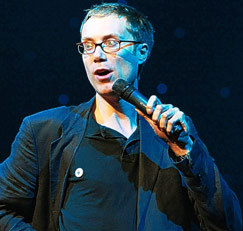 Stephen Merchant: There’s an expectation, right. But your material is half-baked. And you don’t know what you’re going to say. And so it’s tricky that audience expectation is very high. It’s harder, I remember Eddie Izzard said something about stand up, “You need to be brave enough to walk to the edge and then walk off and that’s how you become great”. And I guess since I started doing it again, I’ve probably not had that bravery because of that expectation. I don’t want to disappoint. You kind of get panicked. And it probably makes you more conservative and less ambitious maybe which is a shame.
Ron Bennington: So in a lot of ways that makes it even more difficult.
Stephen Merchant: Well I have the added complication as well I think, if you became well known as a stand up comedian, people at least know what to expect from your stand up routine, but if you’re known as I am in different ways, some people know me as an actor or just from sort of being on a DVD talking about shows with Ricky or on the podcast we’ve done. They know me from different things and none of them are quite stand up and they’re not quite like my stand up. I always feel there’s people leaving the show disappointed. (audience laughs) Like every stand up show, “ehh, that was not my thing”. (audience laughs)
Ron Bennington: Well, do you feel like you’ve found your stand up voice now? Is this the persona?
Stephen Merchant: Well it’s funny because when I used to do it originally I played more of a character. I wasn’t well known so the character was kind of, the idea was me as sort of an arrogant comedian who no one had heard of. And I would come on out and I would start berating the audience. “I am huge in my hometown. You can’t believe you never heard of me.” (audience laughs). And that was fun. And when it went well, it was so much fun. And when it didn’t, they just thought I was an arrogant comedian. (audience laughs). And they had no idea what was going on. But obviously I couldn’t do that anymore because they would have just thought “Why is he being so arrogant? This is such a horrible…” So I had to go back and yes, sort of find the voice, rediscover it and just basically rip off Woody Allen’s act, but with an English accent.
* * * * * * * * * *
Merchant talks about speech, words being taken out of context and the internet:
Stephen Merchant: The other that I think is always scary I think particularly with modern journalism is that any kind of irony and sarcasm is hard to put across because it’s decontextualized. You’ll read interviews in print that you’ve done and I would make that joke in print, but you’d see none of that inflection in my voice, there’s a wink. It just comes out as a cruel mean thing to say or whatever. I’m very jumpy now about that sort of interview.
Ron Bennington: That’s kind of what happened to Twitter where somebody will tweet something and then it becomes, they almost go back to it like the person had a press conference and came out and said “I’m here to say something awful about Obama”.
Stephen Merchant: A newspaper will portray it like they had spoken exclusively to the paper.
Ron Bennington: Instead it’s some guy whose literally half high watching TV, tweeting something like he’s talking to his friend. But a lot of people in sports have been drug down with that.
Stephen Merchant: That happens in the U.K. now particularly. I feel like the policing of what you can say, of what you can make a joke about has become very intense lately. I feel a bit like the U.K. has gone back to the fifties in some way. It feels very conservative with a small “c” now. There’s something about it which I find slightly unsettling.
Ron Bennington: No, it’s very unsettling to me as well.
Stephen Merchant: I don’t know if it’s the same here. I don’t know. There’s a lot of freedom you have on things like Sirius that we don’t have in the U.K. And that’s the thing, I remember, I don’t know if you’re familiar, but Russell Brand, Jonathan Ross earlier, they got into some trouble because they made some sort of crank phone calls and things. And on the radio it got like four complaints. And then the papers picked up on it. And then it was 200,000 complaints. (audience laughs) Old ladies who would never listen to Russell Brand going “He said what? I better complain”. And so now it’s like in a desperate attempt to fill up newspaper columns and people are just leaping on everything and trying to make an event from it, make a story from it. Years ago, that would have just disappeared and evaporated.
Ron Bennington: Exactly.
Stephen Merchant: Now we have to make it into a huge..everybody’s got to humbly apologize. “I’m so sorry. What was I thinking?”
Ron Bennington: And it’s also funny to that you have to apologize to people who did not hear it. They weren’t part of this.
Stephen Merchant: Absolutely.
Ron Bennington: You know it’s one thing if you do something, your audience gets offended. Then I guess you do have a responsibility. A responsibility to people who aren’t following you seems insane to me.
Stephen Merchant: That is bizarre, isn’t it? I do have that thing of if you don’t like something on TV or the radio switch it off. I’m sorry. You can switch it off. To get a complaint…
Ron Bennington: But here’s the other thing Stephen, what about the children? (audience laughs) The thing comes up, “What about the children?” as if they were the most fragile creatures that were ever born.
* * * * * * * * * *
Merchant talks about crazy fans:
Ron Bennington: Well, what’s funny too is a lot of the people who will do that are people at one point that liked you. And then they decide you’ve done something that has crossed the line.
Stephen Merchant: The fans are the ones who turn the most. Because I think the average audience doesn’t care what you’re doing. The average audience is like, they’re not going “Ricky Gervais did what at the Golden Globes?” They couldn’t care less. They’re trying to pay their bills. They’re doing their things. They’re either amused or they’re not. They’re not sitting there going “I wonder what Steve Merchant is doing at the moment.” But the fan is following every word. And so you do something that’s slightly not what they were hoping you do and they’re furious. And God bless the fans. It’s great, but there’s some of them which are psychos. (audience laughs) Absolute psychos!
Ron Bennington: Psychos, God bless them.
Stephen Merchant: A small minority are crazy.
Ron Bennington: And when you first get fans, it’s amazing. The first time you’re like “Oh, people do get me” and then you’re going “Oh God, these people who get me.”
Stephen Merchant: Well that’s the thing, Like I would consider myself a fan of many things. Like I’m a fan of Woody Allen, but I would never, when I shook Woody Allen’s hand go “I’ll tell you what I didn’t like Woody. You’ve got ten minutes, um, I’ll tell you how you could have improved “Manhattan”. It’s like people just want to offer up an opinion to me. I talk about it in the show. A guy just said to me once “Yeah, I saw The Office. Not my cup of tea.” (audience laughs)
Yeah, talk about fans, one of the jokes of the stand up tour has been the idea that I was talking about how I’d been searching for a wife. This is just a comic conceit of the show. And I was in a supermarket the other day and a woman came up to me, with kind of a vague Eastern European accent like she’d be the villain’s assistant in a Bond movie. (audience laughs) Like I wasn’t sure where she was from. And she just said, “Are you Stephen Merchant?” I was like “Oh hi, how’s it going?” She said “Oh I’m a fan. What’s Karl Pilkington doing?” and I said “Oh yeah” so I walked off. And then she reappeared again, just kind of came around the corner and she was like “You sure you’re doing your stand up show?” I was like “Yeah”. She goes “You looking for a girlfriend?” I said “Well, you know..” She went “Do you have a girlfriend?” And I just panicked. I made one up. (audience laughs) I was just like “Yes. Yes I do.” And she went “What’s her name?” Like she started quizzing me on it. (audience laughs) I was like “Um..Allison?” She’s like “Are you spending Christmas with her?” Now I’m thinking like I’ve only just got a girlfriend, will I spend Christmas? Is it too early to spend Christmas with her? Like now I’ve got a whole back story I’ve got to create. “Um..no, we’re not.” And she’s like “Well what’s Allison doing?” I was like “She’s seeing her family. We’ll probably see each other later.” And I’m just making this up. And she’s like “Oh, that’s a disappointment ’cause I would have been sort of interested.” And I was like “Okay, well thank you. That’s really sweet.” And then I left. And then she was like lurking outside the supermarket, just watching me. And then she started following me and I went to get coffee and she was in the kind of line behind me in the coffee shop. This was really making me edgy. And then, I swear to God, she came up to me and she said, we were in this little mall and she said two things. She said “How do you get out of this place?” And then, and I swear to God and I don’t know what this means, she said “Are you a Black man?” (audience laughs) I don’t know what that means. And I said “I don’t know what you mean?” And I think what she was saying was “I don’t believe Allison exists in the same way that you’re not a Black man.” It was so freaky. And then I just left. And I was just looking behind me. Is she following me home? I was so freaked out. Now that is a fan who is a psycho. There’s the example of it right there.
Ron Bennington: And you’re lucky because…
Stephen Merchant: We slept together. I’m not going to lie to you… (audience laughs)
* * * * * * * * * *
Merchant talks about creating The Office:
Ron Bennington: But even in The Office, you could tell that you weren’t making it for an American audience because so many references I still don’t get, which I thought was refreshing. The other thing that I loved about The Office that American TV had fallen into this bit where the star of the show was the straight guy in the middle of this wacky office.
Stephen Merchant: Right.
Ron Bennington: But you guys really went to the, this guy’s somewhat of an asshole and everyone else is just trying to do their work.
 Stephen Merchant: Right. Well it was the idea that in the past, sitcoms had always been some funny zany characters with an office backdrop. Where to us, what was interesting the minutia of office life. We both worked in them and there is something unique about that ecosystem of an office. I don’t care if you work in NASA or anywhere, if someone takes your chair, it’s your chair. (audience laughs) I wrote my name on the back. It’s my chair. Where the hell is my chair? I had a pen. It was tied to my desk. Someone’s taken my pen.
Ron Bennington: So a physicist is going to be pissed about this?
Stephen Merchant: Stephen Hawking would be furious. He doesn’t care.
Ron Bennington: Well the other thing too that I think you guys caught on to that kind of changed in society that the office manager stopped really being that boss and was almost an assistant to everybody who worked for him. You know like “Hey, what do we got to do to get your sales up?” “How can I help you?”
Stephen Merchant: Well I guess that’s sort of the eighties thing of “Let’s loosen the bloody tie and just relax guys. You know we’re all friends here.” “But you will be fired if you don’t improve your sales.” “But we’re all friends. We’re all friends.”
Ron Bennington: “We’re a family.”
Stephen Merchant: We’re a family and all that kind of thing. And in the end, one of the problems I think we try to explore with David Brent was that he makes the mistake, you can’t be the boss and the friend. Because one day you will have to fire someone. And you cannot be their friend at that moment. And it’s worse. It’s far worse if you’re the friend who been at the barbecues and nursed their kids and then you go “I’m going to have to let you go. But how is young Jack?” It’s devastating.
* * * * * * * * * *
Merchant talks about ‘what’s next’:
Ron Bennington: Do you guys keep thinking like alright, what will be the next piece or you just wait for the muse to show up?
Stephen Merchant: I feel like I wish there was more of a game plan. Then there is. I don’t know. I feel like I’m very exhausted at the moment. Like I feel like I’ve been working solidly for sort of ten years and I do feel a little bit like I’ve run dry. Kind of creatively. I need to sort of take a rest and kind of revitalize and reconnect with things.
Ron Bennington: Are you able to do that though? Does it feel like that’s palpable for you?
Stephen Merchant: I’m just gonna hang around in supermarkets. (audience laughs) After awhile someone, a character is going to appear that’s going to motivate me to do something else.
Ron Bennington: But you know when you sit down and look, you’ve done so much in ten years. I mean you pretty much put together at least twenty years worth of work in the last ten years.
Stephen Merchant: Wow. Do you think? That’s really sweet of you. Thank you.
Ron Bennington: Well there’s what, four, five TV shows, the movies, you’re in video games, stand up. It’s kind of ridiculous.
Stephen Merchant: No I am. I’m exhausted. I’m burned out. I’m absolutely burned out. In fact, yeah, I might just take the rest of my life off. (audience laughs) That would be absolutely ideal.
Ron Bennington: You guys still do like to walk up to that line and jump off. As you brought up earlier, I mean you are, the fact that I’ll watch and something will come up where you’re gonna play around with disabilities or mental problems or whatever. And that seems to be something that is almost like a go to place. Like can we get in and out of it?
Stephen Merchant: Like my stand up is much less edgy in that regard. It’s more when I come together with Ricky that’s territory that we tend to go into. But I always try to make sure it’s done with a..we’ve thought it through. We’re not trying to pick easy targets, and be shocking for the sake of being shocking. We’re trying to venture into that territory which  people feel uncomfortable exploring because I think disability for instance, it’s easy to kind of ignore it and push it to the corners and just nod and be polite. I think it’s good to bring that into the kind of comedy spotlight. Because I think that way you explore it and I think you make people less uncomfortable the more you joke about it. I always thought that’s what was so amazing about someone like Richard Pryor, was the way he addressed race. It feels like he was feeding into the loosening up of that. The more he was honest about that, the less easy it was to be racist. And it’s the same to me with exploring any territory. The more you talk about it, that can only be a healthy thing. .So like this new show Life’s Too Short, we’ve done it. And kind of the idea came from this dwarf actor, Warwick Davis. And we worked with Warwick and he said we should do a show about a little person. And inevitably, you’re going to go into uncomfortable territory, but it’s like you need to constantly remind people Warwick co-created the show. It was his idea. This is drawn from his life. It’s his experiences. And people in the U.K. are still kind of “whoa whoa” Really? But this is his life. He’s not playing a leprechaun. (audience laughs) He’s playing a human being. He’s a real man. With demons and frustrations. And I hope that’s a healthy way to approach comedy.
Ron Bennington: But now that’s that challenge that you guys seem like you have to go back there, no matter what happens.
Stephen Merchant: Maybe. Maybe. You might be right. Maybe we’ve painted ourselves into a corner. I don’t know. I’ll just do a musical next. It will be like High School Musical.
* * * * * * * * * *
Merchant talks about following your dreams, and why he loves Bruce Springsteen:
Ron Bennington: Well Cemetery Junction which was this kind of smaller coming of age film. I thought it was really really perfect for that time period that it went back and it was really specific to it. But it certainly wasn’t broad.
Stephen Merchant: Well I think we were trying to do something different that we were trying to be more charming I think. And more sort of nostalgic. And because although we do edgy stuff, that’s not everything. That’s not the sort of beating heart of us. We’re sentimental and that film was kind of inspired in part by a Bruce Springsteen lyric at the end of Thunder Road. There’s a line where he says “It’s a town full of losers and we’re pulling out of here to win.” And that song, Both Ricky and I adore that song. It’s so cinematic. And something about a kind of teenage life and sort of breaking free. That sort of following your dream thing. It may seem corny, but it just seems to me to be as important now as did when I was fifteen or sixteen and thinking what am I gonna do with my life. I often think again if you’re doing something interesting or if you’re in somewhere like New York City, you forget that’s there people who aren’t. There are people who are out there in their tiny little worlds and maybe they want to get free, but they’re from a background that says it doesn’t happen to you. You just work in the local petrol station and live your life and get married and have some kids. My parents weren’t like that, but people I went to school with, were like “You want to do comedy? Are you a maniac? John Cleese does comedy. You don’t do comedy. Who the hell are you to think like that?” And I just think that’s such a dispiriting despairing way of looking at things.
Ron Bennington: And I grew up in the same kind of neighborhood where people are like “You’re going to born here, live here, die here. That’s plenty, but you’ll get really fucked up on liquor and drugs and it will be great.” Like we’ll make something out of it. While we’re high. (audience laughs)
Stephen Merchant: Why not become successful and then get fucked up on liquor and drugs?
Ron Bennington: And get even better drugs. But you’re right about that, that there almost seems this thing of the fact that it stopped being about work. In other words, it became about being famous instead of maybe you can write your own Thunder Road. Not be the guy who wrote Thunder Road and have a huge house.
Stephen Merchant: Right. Exactly. “Maybe one day you could write a song that good.” rather than “ I would love to be Bruce Springsteen. I hear he’s got a private plane.” (audience laughs) It’s like that’s what you want. That’s what’s important to you.
Ron Bennington: Yeah because if you went back to Bruce Springsteen, he’s constantly trying to get back to “Thunder Road” too.
Stephen Merchant: He’s so inspirational to me. Because again, he’s one of these people who’s, he’s always doing something different. I think he’s always pushing himself. He’s always challenging. He’s got that album of Pete Seger folk songs. And he could just rest on his laurels. And just play stadium tours, but he’s always trying to do something. And I just really admire that, people that get into that place. And yes, he’ll never do another “Born to Run” probably because that was of its moment and he was fresh and new and no one had ever seen anything like it. But he still does amazing work. It’s funny. You were saying about taking quotes out of context and stuff. And Ricky always cites something where he was on a red carpet at an event and someone said to him “What advice would you give to someone who wants to be famous?” And he said “Kill a prostitute” (audience laughs) And that’s a great line. But people took it out deliberately and used it like “Ricky Gervais thinks you should kill a prostitute to be famous.” It was a joke! He was being facetious at your inane question. And it’s the same thing. That’s it, yeah.
Ron Bennington: Well if you have taken anything out of this show today folks, it is kill a prostitute. Stephen Merchant. Let him hear it everyone. (applause)
Stephen Merchant: Thank you very much.
======================================
You can hear the full audio of the interview in its entirety (including a pop-in by Simon Pegg) exclusively on SiriusXM satellite radio. Not yet a subscriber? Click here for a free trial subscription.
Follow Stephen on twitter at @smhelloladies and visit his website www.stephenmerchant.com
