
How Being A Great Stand-Up Comic Helped Louis C.K. Realize He Is A Great Actor
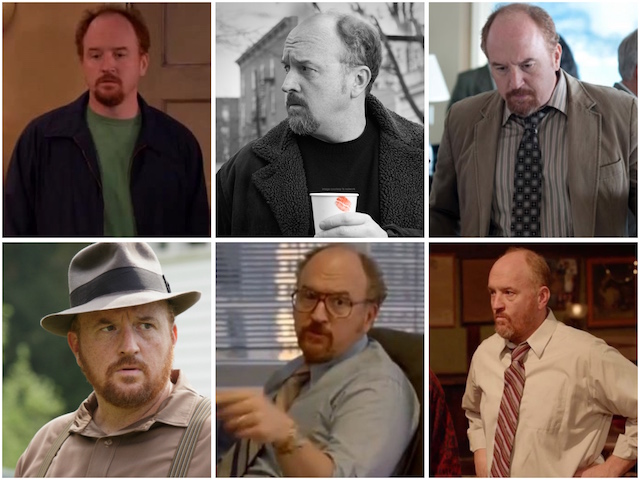
Louis CK gets more than enough credit for being one of the greatest stand-up comedians in the game today, so aside from agreeing that it’s a pretty fair reputation, I’m not going to talk too much about his skills as a comic. For the purposes of this article, I’m talking about Louis’ equally considerable and constantly growing skills as a comedic and dramatic actor, both of which have taken fans and critics by surprise in their depth and the fervor with which he’s been sharing those skills with the world. Louis’ not just a good actor capable of playing out the role he writes for himself, based on his own life—he’s a great actor who’s sought out by directors like Woody Allen, Jay Roach, and David O. Russell for their next critical art house smash films. And he’s hardly the first comic who made this jump with virtually no effort or aplomb.
To understand what’s so remarkable about Louis CK’s sudden emergence as a serious actor, you need to look at his career trajectory. Louis spent several decades as a stand-up comedian and writer, quietly building a reputation as someone who could change the industry when he found his voice, which we now know he eventually did. While writing, he occasionally directed and produced, as well, but he rarely stepped in front of the camera, and definitely didn’t seem to have long-term goals of becoming an actor. In fact, as far as we know, Louis CK had never even taken any serious acting classes when he created his first sitcom, Lucky Louie for HBO. With the series based loosely on his life, Louie felt prepared to take on the lead role, in spite of his complete lack of acting training. This was hardly the first time a stand-up comedian was given the lead role in a sitcom despite a complete lack of acting talent; more on that later.
Lucky Louie was canceled pretty quickly, in no small part because it relied too much on traditional sitcom premises for both its star and its network. Four short years later, CK created Louie, and again he was also the star. This time, the series was a massive critical hit, with each season increasing Louis’ stock as a writer, director, comedian, and most importantly for this discussion, an actor. He’ll still self-deprecate and joke about how he’s not as good as his co-stars, but as the star of an often seriously dramatic and unpredictable show, CK has seen his on screen skills grow and develop layers in a manner a lesser actor never could’ve pulled off.
Thanks to Louie, CK started getting roles in films like Blue Jasmine, American Hustle, Trumbo. These roles usually had a lightly comic element, but they were overall serious films, and CK brought his A-game as an actor every time. His talents as an actor are growing stronger and stronger with each role, and an important thing to note is that his stand-up hasn’t slowed down in the slightest. If anything, with his increased fame, CK is performing stand-up more than ever, too, and his constant performances on stage directly relate to his ability to portray these diverse roles.
Stand-up is the most personal and private form of creative expression there is, but the main goal is always laughter, so the average audience can easily forget just how many layers there are to a truly good stand-up comedian. Most stand-ups aren’t simply joke tellers, they’re storytellers of the grandest variety, weaving reality and imagined scenarios through one continued monologue that, if it’s going to stand the test of time, might say something important about humanity along the way. To create that, a great comic needs to go on an emotional journey not unlike a great literary character, or the audience won’t be able to trust them as a human being in the first place. This is essential, as it’s impossible for an audience to listen to someone ruminate on humanity unless we know that person is an active part of it. While Louis and other comedians could and do accomplish that by loudly and honestly being themselves, to present a more complete view of humanity, they often delve into characters and acting throughout their stand-up, and Louie is one of the best at doing this, too. Granted, he’s hardly alone.
Long before there was Louie CK, there was Robin Williams, who actually did take a few acting classes at Juilliard, but was famously told he should leave because the legendary John Houseman felt Robin had nothing left to learn. Williams was so multi-talented, it’s hard to compare him to CK or anybody in one particular field, but this innate acting ability might have something to do with that unparalleled success in all fields of entertainment. Williams wasn’t just an innately talented actor, he was a constant and consummate comedian. Every moment of his filmed life seemed like part of a prolonged act, and his dramatic films proved there was an amazingly deep range to his chameleonic emotional skill. Jim Carrey is a similar case, and unlike Robin, he’s closer to Louis in terms of his actual acting training.
With the success of these comedians as dramatic actors in mind, it’s worth bringing up the often accepted axiom within the entertainment world that comedic acting is generally harder than dramatic acting. While we’ve pointed to a few examples of comedians becoming actors without training, it’s pretty rare for a great dramatic actor to all of the sudden decide to become a comedian or host a one-man-show, so clearly the overlap of the talents isn’t fluid or interchangeable. Dramatic acting is about making people believe you feel a given emotion and allowing the audience to feel it sympathetically, whereas comedic acting is about making the audience feel something completely removed from what the actor themselves is actually feeling. Since stand-up comedians are often talking about the worst parts of society and their lives, and therefore probably feeling pretty shitty about these things, what they want from the audience is the complete opposite reaction—unbridled laughter and joy about these shitty feelings the comedian has. When you think of it this way, it’s really no surprise at all stand-up comedy is in and of itself a pretty amazing acting school.
I don’t really love the concept of acting school. Really, I should rephrase, because acting school is the smallest part of the bigger problem—I kind of hate the idea behind art school. Don’t get me wrong, I think art of all kinds is fantastic and vital to any sophisticated society, but I very firmly believe art is something that cannot be taught. Talent, whether at acting, writing, painting, stand-up comedy, music, sculpture, or whatever other art there is out there, is not something that can be manufactured. Great artists are born great artists, and there’s no curriculum that can create a great artist out of nothing. There are, however, certain methods through which an artist can hone their skill and get better, namely, practice.
In my opinion, the flaw behind any type of art school (music, acting, or otherwise) is that one shouldn’t attempt to give a grade to mandated forms of practice. Since art is subjective, it’s pretty hard to give any sort of grade to the final product, either, which is why most art schools basically come down to a pass/fail on whether or not all of the classes have been paid for and all of the assignments have been turned in promptly. The good art produced from the schools is created by the people who were already great artists walking in. That’s exactly how it is in the world of stand-up, too, and the more practice a comedian gets, the more recognition and fame they get as a result—not just some diploma that proves they produced a fair amount of quality indeterminate art for several years in a row.
Of course, not all stand-ups somehow turn into amazing actors by default, just like not everyone who goes to art school can produce amazing art. Jerry Seinfeld might have starred in the most popular sitcom in history, but even the biggest Seinfeld fans know he was an average actor at best. Norm Macdonald, Drew Carey, Ellen DeGeneres, Larry David, Roseanne, Ray Romano, Bill Cosby (sorry to bring him up)—these people didn’t exactly turn their sitcoms into Academy Award winning careers, either, although a few were decent enough actors so long as the role they were hired to play was themselves. And then there are comedians like Jeff Foxworthy and Brett Butler, who were such bad actors in their sitcoms they almost destroy my entire point. If anything, though, I feel Foxworthy’s complete lack of acting talent doesn’t destroy the point that some stand-ups are naturally prepared for the screen, but rather confirms the point about stand-up as practice, and practice being better than any school: the whole issue is that some people just never get better, and others were great from the start and just needed some time to let their talent breathe, so to speak.
If that talent is joke telling, stand-up and writing will probably be the limit for the artist. If the talent is emotional storytelling that connects with the audience on a serious level and makes them laugh along the way, there’s really no limit to the kind of acting the artist may be able to handle. Louis CK finally found the showcase for his talent to breathe with Louie, and endless film roles are following him. Plenty of new stand-up comedians will probably start trying to take his journey, but be forewarned if you think stand-up will somehow lead you to becoming a great actor or actress. We wish you the best on your attempt, but keep in mind, true talent can’t be taught—it can only be found.
Read more comedy news, stories, interviews with comedians, videos and comedy clips on our home page. Get more comedy news. Watch more viral videos. Read more interviews with the best comics in the business.
.

Latest posts by Lucas Wesley Snipes (see all)
- You Don’t Like Comedy Classics? You’re Kidding, Right? One Writer Questions History’s Love of the Three Stooges - November 3, 2016
- You Are On The Air: A Timeline of the How Comedy Entered the Race For President - September 25, 2016
- Why TV Needs a Tough Crowd - September 7, 2016
