
Read This Book! Notes From the Bathroom Line Carries A Long-Neglected Comedic Torch into a New Era
Collage created using TurboCollage software from www.TurboCollage.com
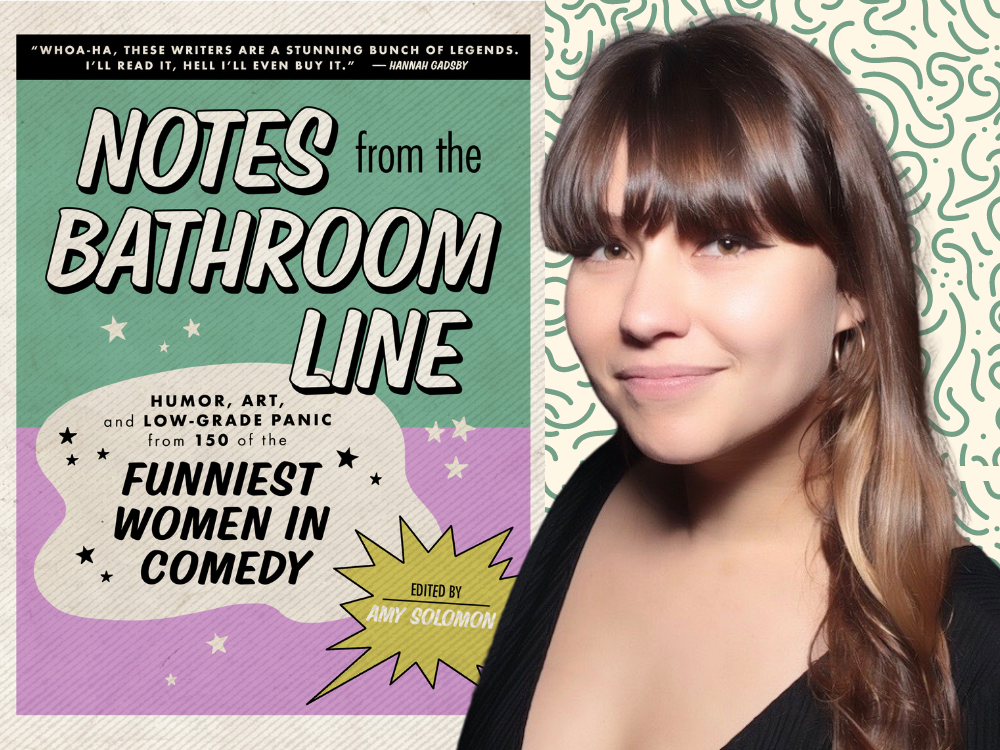
Notes From the Bathroom Line Carries A Long-Neglected Comedic Torch into a New Era
In the eBay deep dives of her teenage years, TV producer and newly minted anthology editor Amy Solomon stumbled upon Titters, a 1976 female comedy collection featuring her idol Gilda Radner alongside women including Laraine Newman, Phyllis Diller, SNL writers Anne Beatts and Rosie Shuster, and many more. She devoured the book and revisited it often, but in later years thought, “It was always absurd to me that there wasn’t another collection of humor by women since then.”
It was the influence that Titters had on her budding comedic sensibility that called her to return to the concept years later – and the result is Notes from the Bathroom Line. Featuring 150 female and nonbinary comedians in a variety of forms (essay, list, comic, doodle, and even songs!), it is the spiritual successor to this seminal work – and, Solomon hopes, a worthy one at that.
Solomon kicked off her book tour at her alma mater, Princeton University, in conversation with former college president Shirley Tilghman. After chatting about her mark on Princeton’s comedy scene through her work with the improv team Quipfire and Princeton’s late night show All Nighter, she brought a few of the book’s contributors – Naomi Ekperigin, Aparna Nancherla, and Cecily Strong – in to talk more about their contributions, the state of comedy for women, and how to stand out in a business that often insists women shouldn’t be there at all. Here’s a bit of what we learned.
The title came from one of the contributors – and represents the wide range of contributions to the book.
Any woman will tell you that the bathroom line at any public establishment is somehow a perfectly mundane and perfectly magical place. Both surface compliments and deep conversations can emerge from that seemingly unending time, which is probably why Rebecca Shaw, a friend of Solomon’s and contributor to the book, found it to be such a perfect title for the book early on. It was meant to be a placeholder in the proposal, but it endured right up until publication – and having read the book, it couldn’t be more fitting.
Conversations that take place in the bathroom line can bring people from wildly different walks of life together, and Notes does that. It features standup comedians like Ekperigin and Nancherla, sketch and improv performers like Strong, D’arcy Carden, and Sasheer Zamata, comedic actresses like Beanie Feldstein and Aya Cash, satire writers like Sarah Pappalardo, and many many more.
What’s more, these line conversations span a wide range of topics, and Solomon said this was actually her biggest concern as she solicited submissions, edited them down, and placed them in the framework of the book. “I think a lot about, how is what I’m saying reflecting on women? I can’t imagine men ever think about that.” Women can be funny about a lot of things, she went on to say, and she never wanted the book to be a place that showed women only as funny in the context of relationships, or sex. To that end, there are sections of the book with comedy about identity, family, socializing, navigating life, and more. And at every turn, no matter the topic, the women called upon to write – or draw, or sing – found the funny.
Finding the funny can’t happen in a vacuum. When asked by an audience member (and, as we learned later, fellow book club member) what surprised her about the book editing process, Solomon cited the solo element of it. With a background in TV (she runs Alec Berg’s production company, working on shows like Silicon Valley and Barry), she’s accustomed to work that is far more communal. “Everything I do for work in TV is very committee, feels like a group project.” In contrast, when a submission needed notes or cutting down, that decision fell to her…and it wasn’t always a decision she felt prepared to make – “I can’t send Cecily notes on this!” was one example.
The other women on the panel echoed that feeling of needing someone to help reflect on if a joke works or is ready for audiences. When asked by President Tilghman how they know if something is funny, Ekperigin responded, “If it makes me laugh, it has a pretty good chance of making people laugh. If you like, you’ll deliver it well.” Strong generally agreed, while also noting that sometimes it can be too niche – “I’ve written so many things that are clearly just for me, and I find out in dress rehearsal.” Ekperigin added, “There’s something about being across from a person that turns me on in a way that I don’t do for myself,” a realization that has had her Facetiming with friends or leaving voice notes to work out new material.
And the book finds ways to address this communal sense of finding a joke. In each section, there are collections of answers to a question asked of all the contributors – for example, in the Entertainment section, we get dozens of answers to the question, “What’s a movie/TV show/book that you constantly pretend to have seen or read that you certainly have not seen or read?” Each contributor finds their own take on the answer, and what results is a two page spread of uniquely funny answers – something often not assumed of a group of women.
And speaking of funny women, they’re here. They’re real. And they’re funny in at least 150 different ways.
One of the early questions posed to Solomon asked about who turned down the chance to appear in the anthology. “So many [nos],” she admitted, before affirming the anthology that she did eventually compile. “I do believe that the women who ended up in this, those are the women who are meant to be in it […] it was a joy to lightly edit their work.” She said a moment later, “The excitement of the yeses was way more fun than the sadness of the nos.”
About that naggingly persistent question, especially in standup, of “are women funny?” Ekperigin confirmed that the trope is “still alive and kicking.” She admits to having bought into parts of it earlier in her career. “I don’t perform with the idea of I’m not funny, but [more that] they expect you to say a certain thing. I was always very mindful of that, especially in the beginning.” Nancherla agreed, noting, “There were a lot of rules about what you’re supposed to be, or what you’re not allowed to do It feels more rigid for women, even if it’s not overtly said.”
But in Notes from the Bathroom Line, these boundaries go fully unheeded. Each contributor, in their uniquely funny submissions, manages to go deep on what they care about. What results is a collection of heartfelt, silly, at times serious, and generally affirming pieces.
Notes from the Bathroom Line is available now from booksellers everywhere.
Read more comedy news.

Amma Marfo
Latest posts by Amma Marfo (see all)
- How Fifteen Years of Pep Talks Helped Joyelle Johnson “Love Joy” Onstage - November 6, 2021
- Ms. Pat’s BET+ Sitcom Flips the Familiar Format Her Way - August 24, 2021
- JFL Awards Highlights! Just For Laughs Honors the Bright Spots of a Largely Unfunny Year - July 31, 2021
