

Seen at SXSW: Late Night’s Girls Club on Remote Work, Finding Your Groove, and Not Caring What the Boys Are Doing

Seen at SXSW: Late Night’s Girls Club on Remote Work, Finding Your Groove, and Not Caring What the Boys Are Doing
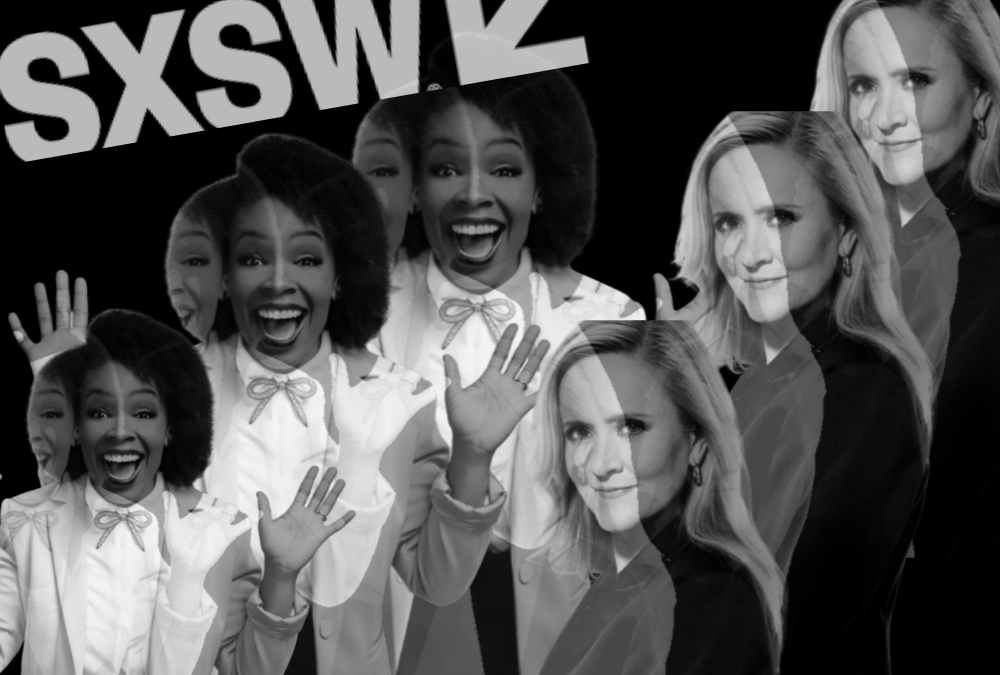
When an “in conversation” event goes well, you can forget that you’re in on something public. The chat meanders and reveals personal things, and the audience leaves feeling as though they’ve simply sat in on a chat between old friends. This public meeting of (part of the) Late Night Girls Club, featuring Full Frontal’s Samantha Bee and The Amber Ruffin Show’s Amber Ruffin, felt exactly like that.
There were ringing landlines, cameos by cats, and adapting to late day sunlight. But by the end, we got a deeper sense not just of how these women go about creating topical comedy, but of their appreciation for one another’s work. Among the highlights of the laugh-filled hour?
Full Frontal with Samantha Bee adapted early and often, thanks to Sam’s Canadian pragmatism.
One of Amber’s first questions for Sam was about the show’s pivot to remote filming in the earlier stages of the pandemic, and what it’s been like to return to a more traditional setup. Sam blames the quick move and continued production on being “pragmatic in a super Canadian way,” but also on feeling a need to offer a sense of routine – for herself, as things got scary, but also for her team and everyone depending on the show for continued income and stability. “We were terrified about the show, but more terrified for the world,” she said.
Full Frontal has since returned to the studio, but what you likely didn’t notice is that it is a different studio from their pre-pandemic days. Moving to a smaller (and audience-space-free) rented studio, Bee said, eliminates the need to play to where the audience would normally be, but also creates more control over following COVID precautions. The new setup features six people on the floor at most, and includes remotely controlled cameras to minimize the size of the crew. And as for the possibility of never having an audience like they once did, Bee said “I wouldn’t be that sad. It’s actually okay.”
The Amber Ruffin Show will, in some ways, adapt in opposite ways from Full Frontal.
For Ruffin, the adaptation experience was less about moving the show, and more about starting the show. Admitting to feeling like she’d wished on a monkey’s paw (“I should have been more specific!”), she nevertheless committed early to doing a show in studio. “They asked me, ‘do you want to do it at home?’ NO! I can’t be here anymore!” The COVID protocols her show adheres to are secured in a manner different from Full Frontal; because she shoots on the same set and with the same crew as Late Night with Seth Meyers, many of those people are already tested frequently and the same protections are being extended into her Friday night shoot days.
But unlike Bee, Ruffin is ready to see how her show would play to an audience. “My background is in theater and improv, so I’d love to have an audience!” And yet, she sees the time with just her team in studio as a gift: “there are simply no rules. We’re trying to discover what the audience wants and what we like to do.”
Despite being in the late-night game, both are relieved in the moments where they don’t have to have a political take on things.
In one of the best exchanges of the conversation, Ruffin asked Bee how she processes the news outside of the context of work. Bee admitted to being far more deliberate about how she takes in news personally, and disliking the culture we’ve built that requires an immediate “hot take.” She shared that she was originally slated to be a guest on The Late Show with Stephen Colbert on what ended up being the night of the January 6th insurrection, and that she was relieved to be bumped. “I’m slow to work out my feelings about things – and [I] didn’t know yet.”
As Bee turned the question back on Ruffin, they shared difficult memories about the one day Ruffin felt distracted and hurt to the point of being unable to work: the confirmation hearing testimony of Christine Blasey-Ford. “That was gutting, that was the worst day ever,” she remembers. “That was straight up scary.” She recalled all the women in the office being “two seconds from crying, all day, and the men just not wanting to say anything.” Bee jumped in to reminisce along with her, remembering being curled up in her office, watching from a couch under a blanket, feeling “really awful.”
Bee sees the difference in each late night’s show take not coming from gender, but from individual stories.
The late night women’s club is small – it was 2/3 represented on this call (absent was A Little Late’s Lilly Singh), and yet it generates a lot of talk about how it might be different from the approach of the otherwise male, largely white, landscape of late night news. But Bee doesn’t worry too much about that as she goes about making Full Frontal. “I don’t give a shit about what the boys are doing,” she whispered to camera.
When Full Frontal first started, she shied away from some of the more common topics that her peers were covering on their shows. What she eventually realized was that “the takes would be different because we’re different,” and she leaned more into bringing the voice or perspective that wasn’t being shared to those common stories. “What you’re steeped in is what emerges,” noting that she and Ruffin could opt to take on the same stories and they’d likely still present really different takes.
Ruffin is still finding her footing in this space. Having premiered on streaming, she’s felt less pressure to define what the show is or what it will do. She follows some traditional trappings of the form – monologues, occasional musical numbers – but she’s really valuing that her perspective can be dictated really freely as her format continues to solidify itself. And with a recent renewal carrying her through to at least September 2021, she’ll assuredly have more time to find that groove.
Both Bee and Ruffin are ready for the nuance and incidental contact that make comedy so much fun.
Even though they’ve produced work, and produced good work, during the pandemic, each is ready for a semblance of normal that brings them back in close contact with other people. Not because of boredom with home – each goes to work in studio – but because the comedy is best outside of the confines of remote work.
For Ruffin, it’s the static nature of emojis that’s getting her tripped up – “there’s no vibes to catch! It’s just a [static] thumbs up or thumbs down.” And for Bee, not having the feedback of a writer’s room and all the body language and reading of faces that lets her know if something’s working that has her feeling off-kilter still. “So much of what makes this enjoyable is that interpersonal communication […] everything is just so coordinated and curated. It’s still fun, but I can’t believe I’m saying I wish I was in an office with my coworkers.”
In the meantime, we can look forward to some unnamed but enthusiasm-inducing segments from Full Frontal, including a way to safely create travel pieces; and we can expect a forthcoming piece from The Amber Ruffin Show on rollerskating. In either case, this meeting of the Late Night Girls Club was a wonderful one to drop in on – landline interruptions and deer screaming included.
Full Frontal with Samantha Bee airs Wednesdays at 10:30pm ET on TBS; while The Amber Ruffin Show premieres Friday nights on Peacock.
Read more comedy news.

Amma Marfo
Latest posts by Amma Marfo (see all)
- How Fifteen Years of Pep Talks Helped Joyelle Johnson “Love Joy” Onstage - November 6, 2021
- Ms. Pat’s BET+ Sitcom Flips the Familiar Format Her Way - August 24, 2021
- JFL Awards Highlights! Just For Laughs Honors the Bright Spots of a Largely Unfunny Year - July 31, 2021
