
A Look at Saturday Night Live’s Excellent Record of Showing Why Black Music Matters
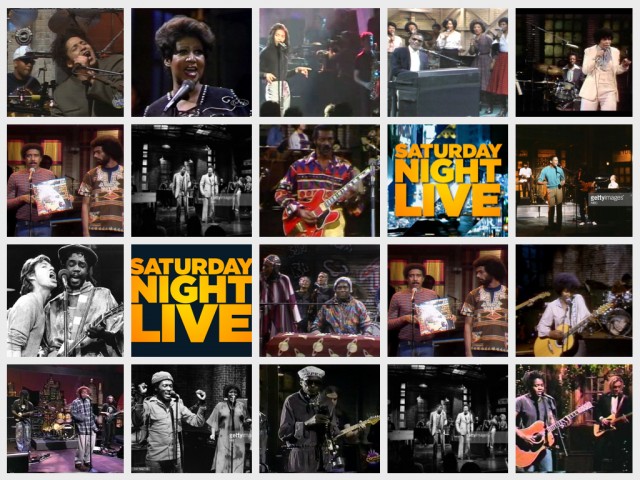

In the wake of the controversy surrounding the Oscars, The Grammys, and even the Super Bowl halftime show, the issue of presenting diversity within the entertainment has been front and center. But throughout its run, a strong case can be made that Saturday Night Live has been the one network show that has consistently presented the full spectrum of Black Music and its contributions to the pop culture landscape.
Whereas a lot of producers and programmers concerned themselves with how certain Black acts would ‘play to middle America’, Saturday Night Live, with its feet firmly planted in the counterculture, set the tone in its premiere episode by having Billy Preston – who was riding a wave a million selling singles and best known for his work with The Beatles and The Rolling Stones – as the show’s first musical guest. I’m sure that Lorne Michaels butted a few heads with the network brass over this decision, but once it happened, it made one thing crystal clear: This wasn’t just another sketch comedy/variety show. SNL wasn’t just looking for someone who was hot. They were looking for acts who were cool.
It reached new levels of cool, too. When Richard Pryor made his historic and controversial appearance (so much so that the network insisted on putting the show on a 7 second delay, which still stands), Gil Scott-Heron was tapped to perform his equally politically charged hit, ‘Johannesburg’. Considering that many of the show and network sponsors had direct and indirect financial interest in a country that practiced apartheid, having Scott-Heron play that song was seismic. Reggae was still making its foothold in the States, but that didn’t stop SNL from having singing sensation Jimmy Cliff (the star of another politically charged film, ‘The Harder They Come’), as a featured guest. One of the show’s earliest musical highlights was when reggae star Peter Tosh – who left The Wailers for a solo career – performed his hit, ‘Don’t Look Back’ with special guest Mick Jagger. Jazz was experiencing yet another creative rebirth and SNL featured three artists known for their vocal pyrotechnics: Betty Carter, Al Jarreau and the late and sadly missed Esther Phillips. Season 1 would also go on to featured the sophisticated soul of The Stylistics and the earthy folk of Bill Withers.
The SNL crew never fully embraced disco. In fact, they went to great lengths to avoid it. Instead, they opted to pay homage to, or give a haven for, several R&B, soul and jazz pioneers who were in danger of getting phased out. Ray Charles became the first Black artist to serve as both host and musical guest. He was also featured in a memorable sketch in which a record producer (played by Garrett Morris) tries to convince Charles to have a young white group sing a safe, sanitized version of his hit, ‘What I’d Say’. Unconvinced, Charles and his band – many of whom were part of the original recording – perform a scorching version of the song as it was meant to be heard. Cast members John Belushi and Dan Aykroyd loved Black music so much that they modeled The Blues Brothers after the great Stax-Volt revues of the mid to late 60s. They even hired Steve Cropper and Donald ‘Duck’ Dunn of Booker T & The MGs to round out the band. The success of the Blues Brothers directly led to the renewed interest in Sam & Dave, who all but burned down the Studio 8H stage when they appeared on the show in 1980. Ornette Coleman and Sun Ra introduced a new generation of their brand of intergalactic (and interstellar) jazz, while Herbie Hancock ushered in a new brand of Afrofuturistic funk when they made their respective SNL appearances. Hancock’s musical mentor, Miles Davis, capped off his amazing comeback during a rare network appearance in 1981. Aretha Franklin, James Brown, Junior Walker and The All-Stars, and Percy Sledge are just some of the acts that got career second winds after making appearances on Saturday Night Live.
Rock n roll has been another SNL mainstay, but by the time SNL hit the air, the notion of Black folks playing rock n roll, much less having them appear on television was pretty much dismissed without a second thought. Once again, the SNL roundly dismissed this by having rock n roll pioneer Chuck Berry show who was really the King Of Rock during his 1977 stint as musical guest. It wasn’t limited to gender or country either. British singer-songweiter-guitarist Joan Armatrading was able to confirm her stateside breakthrough by performing an intense set in the spring of 1977. Just over a decade later, Tracy Chapman put introspection back into pop music when she appeared in support of her Grammy-winning debut album. Any notion that Black folk ‘couldn’t play rock’ was dismissed when New York natives Living Colour and L.A.’s Fishbone absolutely crushed it on their respective SNL hits. Terence Trent D’Arby had the Studio 8H crowd on its feet when he took the Stones’ ‘Under My Thumb’ to rock n roll church.
SNL’s love for Black Music isn’t something that is regulated to its past either. Some of the strongest and most memorable performances in the show’s 40 plus year run has happened in the last couple of years. D’Angelo‘s performance of ‘The Charade’ placed emphasis on the recent rash of police shootings of unarmed Black men and the ‘Black Lives Matter’ movement. The beginning of Kendrick Lamar‘s ascension to the top of the pop culture chain started with his electric 2014 appearance that showed hip hop could be as dramatic and theatrical – while rocking out too – as any other musical genre.
So as Black History Month comes to a close, take a moment that reflect on how one show was able to show Black culture in all of its range and beauty. For the acts that are unfamiliar to you, take time out to hear their work and support their art.
Black Music Matters too, and a comedy institution- Saturday Night Live- recognizes it loudly and proudly.
Read more comedy news, stories, interviews with comedians, videos and comedy clips on our home page. Get more comedy news. Watch more viral videos. Read more interviews with the best comics in the business.
.


Latest posts by Earl Douglas (see all)
- Earl’s World: The Filtered Excellence: September 7, 2021 - September 7, 2021
- Remembering Fez Whatley - August 15, 2021
- Earl’s World: The Filtered Excellence: July 23, 2021 - July 25, 2021
