
Lock Yourself in Weekend: Sam Peckinpah
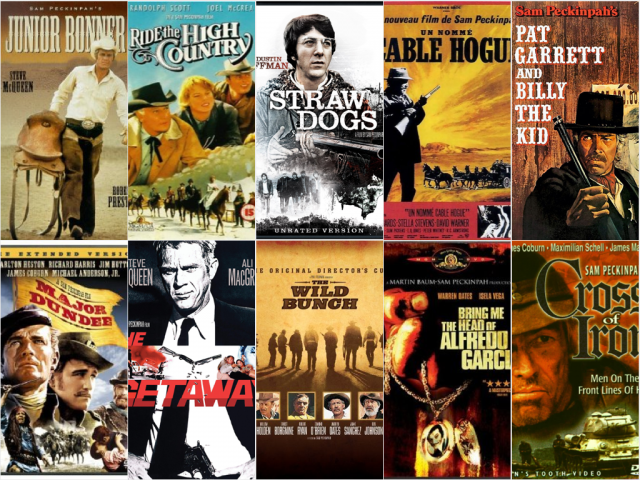
Sam Peckinpah’s reputation as a filmmaker glides between that of a profound artist to an abusive misogynistic peddler of violence. His films were usually about outsiders attempting to survive or succeed in a grim and evil world. Style wise, he’s perhaps best known for his emphatic visual slow motion during action sequences which inspired its usage by other directors. Many of his movies were tainted by issues on and off the set, whether it be studio meddling or Peckinpah’s own temper or his drug abuse. Many of these final products received, at best, lukewarm reception; Peckinpah usually blamed his film’s box office troubles on his lack of control over the final cut. Such examples include ‘Major Dundee’ and ‘Pat Garrett and Billy the Kid’ which were panned on release, but gained in reputation with restored footage of special editions and director’s cuts. His wild lifestyle of alcoholism and cocaine use lead to poor health in his later life and an early death at the age of 59.
Ride The High Country (1962)
Peckinpah’s 2nd feature film. Joel McCrea is Steve Judd, a former lawman hired to escort a shipment of gold to and from a mining town in California. Since his retirement as a marshall, Judd has had a dubious employment history, and is eager to finally use his skills for respectable work. He hires on an old friend, Gil, who now carnies as a ‘famed’ sharpshooter, and his younger business partner, Heck. Along the way they encounter, and reluctantly bring along Elsa, a farm girl who wants to escape her dull religious life by marrying her miner fiancee. The shipment collection goes well, but the group gets embroiled in a feud when they rescue Elsa from her now abusive husband and his brothers. Pursued by the jilted groom and his family, Judd and Gil are torn between keeping the gold shipment for themselves, or adhering to the just path that has seemingly done little for them. The film was released as the lesser on a double bill even though the film had tested positive with audiences. Upon release in Europe, it won best picture in several film festivals and critic’s awards. Rent Ride The High Country
Major Dundee (1965)
After the success of “Ride The High Country”, Peckinpah had caught the attention of Hollywood, and was pursued by Charles Heston to direct his next film, Major Dundee. The eponymous Dundee, although a capable and seasoned commander, is a glory seeker whose brash actions cost him his commision during the Civil War. His command is punitively transferred to a secluded Union prison in the New Mexican territory. Dundee arrives after an Apache attack wipes out a local town and the Union regiment defending it. Desperate to replenish his troops he recruits volunteers and Confederate prisoners. Tyrene, an old rival of Dundee’s and now a Confederate prisoner, is coerced to lead the Confederate troop on the campaign. Both must balance each other’s ego’s and the hostility between their respective men, while illegally maneuvering through Mexican territory in search of the Apache. The movie’s original runtime was rumored to be over four hours, with long bloody sequences influenced by Kurosawa’s the Seven Samurai. The film was the first of the many troubled productions of Peckinpah, which he dealt with through drinking and angrily firing film hands for frivolous reasons; one incident was so heated that Charles Heston to threaten to run through Peckinpah with his cavalry sabre. Rent Major Dundee
The Wild Bunch (1969)
Arguably Peckinpah’s most famous movie, the Wild Bunch follows a gang of aged outlaws that are facing extinction in a modern society. The Wild Bunch is ambushed and hunted by local law and aided by a former member. In order to escape the growing heat from the law and mercenaries hired to kill them, they escape to Mexico and sell their services to a Generalissimo. Their aspirations for freedom sour as the gang attempts to remain honorable towards one of their own. This was notably his first movie that used slo mo action sequences in the final cut; the technique relied on several cameras, each with different frame rates filming the action. Peckinpah insisted that the film’s violence be gritty and real to show the brutality and reality of the Old West. Peckinpah also believed the orgy of violence would be a release for the audience and was somewhat displeased at the jovial reception of the final stand off. Rent The Wild Bunch
The Ballad Of Cable Hogue (1970)
A very different kind of film for Peckinpah, The Ballad of Cable Hogue is a light hearted movie, relatively speaking, about a failed prospector’s misadventures. Cable is abandoned in the desert by his partners after it becomes clear there’s only enough water left for two. During a sandstorm Cable, near death, clutches sand and uncovers the only source of water for fifty miles. His water hole becomes a new found fortune and a meeting point for a diverse cast of wayfarers: a sexually lewd preacher (David Warner), a local prostitute (Stella Stevens) and Hogue’s old partners (Strother Martin & L.Q Jones) The humor is a mix of Benny-hill style fast forwarded silly chases, and somewhat dry humor that fails at times and makes you wish the script was tighter. Peckinpah surprisingly picked this project over directing ‘Deliverance’ and ‘Jeremiah Johnson’. Order The Ballad of Cable Hogue
Straw Dogs (1971)
Dustin Hoffman stars as David Sumner, a mathematician who elopes from the violence of the Civil Rights and Vietnam protests with his wife Amy to her childhood home in England. David’s aloof and bookish demeanor clashes with the masculinity of the local blue collars. Due to David’s inability for confrontation, the local toughs bluntly disrespect him, which gives reason for his wife to chide him. Amy exacerbates the situation by dressing provocatively and acting openly childish to provoke David. When a situation arises that will lead to the killing of mentally handicapped man residing in the Sumner home, David finally decides to fight back. Peckinpah explores the thought of man’s basic territorialism, and argues that David is the true villain of the piece for goading the other men into the violent climax of the film. Once again the violence garnered notoriety for Peckinpah, and the inclusion of a rape scene in which Amy is partially depicted as ‘enjoying it’ did little to sway public opinion. Order Straw Dogs (Unrated Version)
Junior Bonner (1972)
Steve McQueen, in his first collaboration with Peckinpah, stars in the title role as Junior ‘J.R’ Bonner, a broke and beleaguered rodeo cowboy visiting his hometown and fractured family. Junior’s brother has ‘made good’ as a businessman, to the chagrin of Junior and his deadbeat father, Ace, who both cling to a more carefree simple life. Ace confides to his younger son, his dream of prospecting and ranching in Australia, prompting Junior to enter the local rodeo to help his old man out and keep his own head above water. Junior Bonner stands out in Peckinpah’s career as the only film with no gunplay and little to no violence. Peckinpah was eager to make the film weeks after returning the US from the production of Straw Dogs as he was afraid of being typecasted; it also helped that the themes of Jeb Rosebrook’s script aligned with those usually represented in Peckinpah’s works. Order Junior Bonner
The Getaway (1972)
The most commercially oriented movie that Peckinpah had undertaken, The Getaway is an action thriller starring Steve McQueen and Ali MacGraw who are on the run after a botched heist. The production was mostly orchestrated by McQueen, who also, to the displeasure of Peckinpah, had final cut of the film. The film is all about action (and it needs to be with Ali MacGraw’s acting) with explosive gun battles and hectic chase sequences common to McQueen movies of the era. The ending shootout is one of the finer done by Peckinpah, with his slo-mo trademark being used to punctuate the violence on screen. The film itself was one the better Steve McQueen movies of the era, and was one of the few commercially successful films for Peckinpah. However, Peckinpah had little control over the film and felt betrayed by McQueen who had more control over the film and elected to use ‘safer cuts’ to protect his own image. Rent The Getaway (1972)
Pat Garrett and Billy The Kid (1973)
The movie stars Chris Kristofferson as Billy The Kid; Kristofferson brought along Bob Dylan to do the music for the movie and to play a small role as the entirely fictitious ‘Alias’. It takes place in the twilight of the lawless West as modernization and federal agencies begin to take over. Pat Garrett, played by James Coburn, and Billy the Kid are of the same breed, but their differences lie in their willingness to accept the changing landscape. Bob Dylan’s score is mostly negligible, but the usage of “Knocking on Heaven’s Door” is one of the most powerful moments of music in film. The original release was disavowed by much of the cast and crew, and sadly it is the only version on Netflix. Peckinpah was proud of his pre-release cut, and despised Dylan’s inclusion in the cast and soundtrack as it was a choice of the studio and not of his own. Rent Pat Garrett & Billy The Kid
Bring Me The Head Of Alfredo Garcia (1974)
The plot centers around Bennie played by Warren Oates, a small time piano player and big time loser, that seeks any means to escape his cheap cantina lifestyle. His stars seemingly align when a large bounty is placed on Alfredo Garcia, a local womanizer that crossed the all powerful and enigmatic, El Jefe. Bennie discovers that Garcia is already dead and buried through his prostitute girlfriend Elita, who has had numerous trysts with Garcia. Bennie seizes this opportunity to gain a better life for Elita and himself. Yet, what should be a cakewalk becomes a bloodbath as other bounty hunters and petty criminals get wise to Bennie’s knowledge. Although begged by Elita to give up and settle down, Bennie is undeterred, believing that “Nobody loses all the time.” Peckinpah called this his ‘most complete’ work, most likely due to the fact that he filmed in Mexico without using a Hollywood crew and finally had final cut for once. It is also said by those around him to be his most autobiographical film, with Warren Oates basing his performance and look on Peckinpah (Bennie’s signature sunglasses were borrowed from Peckinpah). The film’s reception varies from one of the worst films made, to Peckinpah’s, and Oates’s, finest. Order Bring Me the Head of Alfredo Garcia
Cross of Iron (1977)
Peckinpah’s last glimmer of greatness and his only war movie, Cross of Iron is based on the book, “The Willing Flesh” and depicts a Wehrmacht company on the Eastern Front during World War 2. The movie stars James Coburn as Sgt.Steiner, an anti-authoritarian Iron Cross recipient whose main allegiance is to his men. He butts heads with the inept aristocrat Captain Stransky who has recently transferred to the Eastern Front to ‘win’ the Iron Cross. The Third Reich is past its high-water mark: nearly everyone is worn out or on edge as morale is low from “defeat after defeat, followed by impending defeat”. The odds are stacked against Steiner and his platoon as they fight against the innumerable Soviet military and traitorous elements within the Wehrmacht. The movie found little audience as it was released the same month as Star Wars, yet critics enjoyed it and Orson Welles called it the greatest war film since “All Quiet On The Western Front”. The film is also noted for its use of authentic weapons, which were surplus items supplied by the Socialist Republic of Yugoslavia, where the movie was filmed. Order Cross of Iron (Widescreen Special Edition)
Read more comedy news, stories, interviews with comedians, videos and comedy clips on our home page. Get more comedy news. Watch more viral videos. Read more interviews with the best comics in the business.
.
