
Remembering The Greatest: A Few Words About Muhammad Ali
The passing of Muhammad Ali leaves the world without one of our greatest teachers. But like great teachers, the lessons that he left us will transcend time. The greatest of these lessons that the man formerly known as Cassius Clay left us was to be free, pursue love, and just as important, show love.
Enigmatic, charismatic, engaging, insightful and always the funniest person in the room, Muhammad Ali was free in every sense of the word and encouraged us all to live the same way.
There’s been a couple of reports that I have read that Ali ‘transcended race’. I respectfully disagree. Before ‘Black Is Beautiful’ became vogue, Ali told anyone who would listen how pretty he was. When Black men were jailed and lynched for asserting their rights as human beings, Ali said without fear that he was going to be the person that he wanted to be, not the way others wanted him to be. At a time when Black folk were told that they could only go so far in a global society, Ali declared that impossible was nothing. Ali repeatedly asking Ernie Terrell ‘What’s my name?, during their 1967 fight was directed more at those who questioned his name change as much as it was at Terrell. It was a strong rebuke to the days when the masters would beat their slaves into saying their new name. Muhammad Ali was the living embodiment of being a free Black man in America and encourages others to be the same.
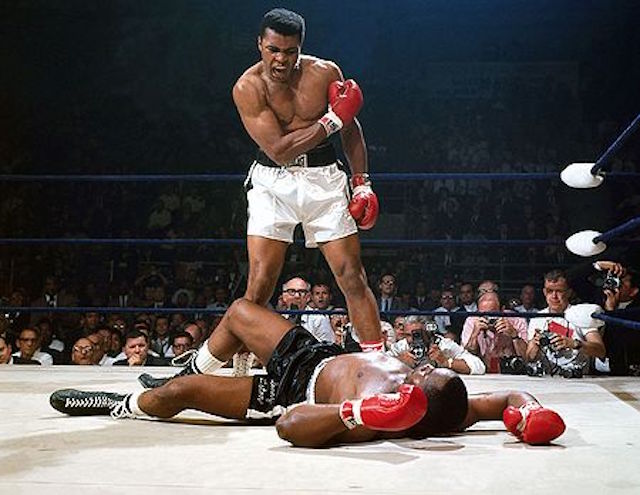
Put it this way: The biggest movers and shakers in the political, entertainment and sports world gravitated to him. Jim Brown, Sam Cooke, and Bill Russell became friends and co-conspirators in how to elevate the lives of Black folks. The Nation Of Islam went from a cult sect to a major player in the socioeconomic political scene. Ali’s refusal to be inducted in the U.S. Army gave the anti-war movement the traction that it needed and spurred Rev. Martin Luther King Jr. to speak out against the Vietnam War. Frank Sinatra didn’t just want ‘great seats’ to the first Ali-Frazier fight at the Garden. He wanted to be as close to the action as possible. So much so, that he got a photo pass from Life Magazine in order to smell the sweat. Howard Cosell was a fledgling sportscaster for the equally fledgling ABC Sports. While his colleagues were put off by the brash, trash talking fighter, Cosell knew better. Today, you can’t talk about one without talking about the other. Neil Leifer was an aspiring photographer looking to get his work recognized on a national level. He too, was captivated by Ali’s charisma and enthusiasm. Today, Leifer’s career is defined by the iconic shot of Ali standing over a fallen Sonny Liston.
Ali also taught the power of remaining true to your convictions despite all odds. He could have easily accepted his induction, did an Army stint that would have involved little or no combat and maintained a successful career in the ring. But Ali recognized the symbolism and hypocrisy behind it all and was ready to risk everything – including his freedom – to stay true to himself. History proved him correct.
Another great Ali life lesson: Down doesn’t mean out. During the first of his three wars with Joe Frazier, Ali is knocked down by a left hook that could’ve taken down a tree. Instead, he’s up as fast as he went down and – despite only having two fights in three and a half years – goes the distance with a peak form Frazier. Despite this crushing loss, Ali presses forward, winning six straight fights with the hopes of getting a rematch with Frazier. A stunning loss to Ken Norton – in which Norton breaks his jaw – has Ali at another crossroads. Despite calls to retire, Ali continues, besting Norton and Frazier in their respective rematches.
Perhaps Ali’s greatest lesson – one that he applied for the remainder of his life – was that impossible was nothing. He wasn’t supposed to win the Gold Medal in the 1960 Olympics. No way, that at the age of 22, Cassius Clay was going to beat the unbeatable Sonny Liston, not once, but twice. Ali has no chance of beating the United States government. Ali’s past his prime, no way will he beat George Foreman. Ali’s out of shape and old, no way will he win the title a third time. Parkinson’s has got the best of him, he’s going to need help lighting the Olympic torch. Yet again, his detractors have a big slice of humble pie. Ali taught all of us that if you have the will, you can do it. When you have the will, “impossible is nothing”.
I witnessed firsthand just how much people loved Ali. When I was about 10, my brother and I are walking along Northern Blvd after a trip to the store. A slow, quiet, Sunday afternoon that was turning into evening. A car pulls over, the driver opens the door and out pops Ali. He starts walking directly towards us and we are freaking out. We actually argued over who was going to carry the box of cereal so that the other will be the first one to shake his hand. The first thing we notice is how big he is. I mean, he just looked what a top flight athlete should look like. Large, soft hands and a smile that could outshine the sun. Before long, people are shouting out of their windows: ‘What’s up, Champ! Love you Champ!’ Cars pulled over and people got out of their cars with the engines still running. People came out from EVERYWHERE and Northern Blvd became a parking lot. Shut down. Ali shook hands, shadow boxed, told his always engaging rhymes, did magic tricks, the whole nine. It was one of the greatest outpourings of pure love I’ve seen.
Muhammad Ali may be gone in body, but his spirit – that loving, caring, inspiring spirit will live on with his family, friends and fans.’
Much love to his wife Lonnie and the entire Ali family and crew.
Rumble young man, rumble….
Rest easy Champ.
Read more comedy news, stories, interviews with comedians, videos and comedy clips on our home page. Get more comedy news. Watch more viral videos. Read more interviews with the best comics in the business.
.


Latest posts by Earl Douglas (see all)
- Earl’s World: The Filtered Excellence: September 7, 2021 - September 7, 2021
- Remembering Fez Whatley - August 15, 2021
- Earl’s World: The Filtered Excellence: July 23, 2021 - July 25, 2021
